

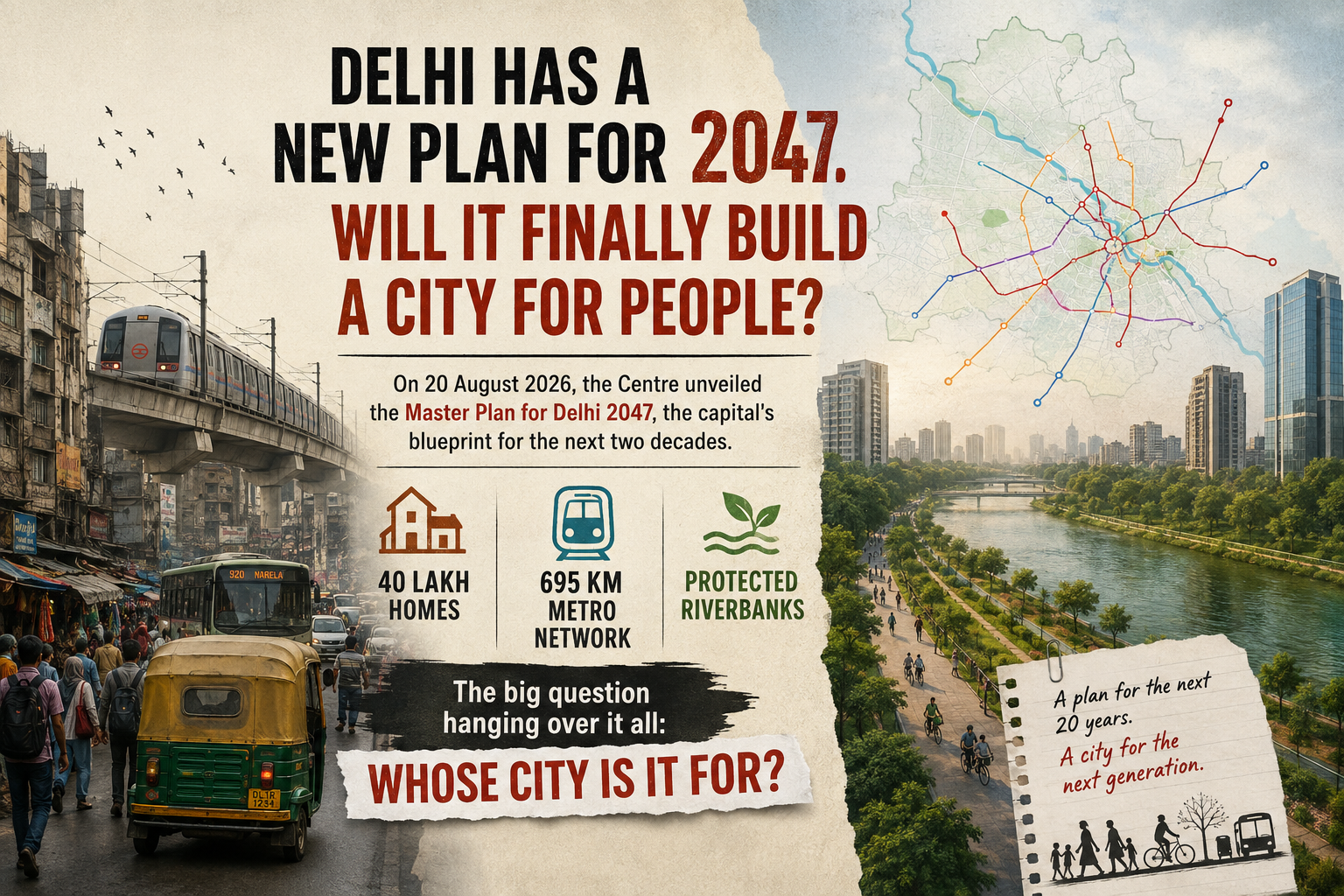
New Delhi: On 20 August 2026, the Centre unveiled the Master Plan for Delhi 2047, the capital’s blueprint for the next two decades. It promises 40 lakh homes, a metro network stretching to 695 km, and protected riverbanks. The big question hanging over it all: whose city is it for?
What was launched, and by whom
Union Housing and Urban Affairs Minister Manohar Lal Khattar unveiled MPD-2047 alongside Delhi Lieutenant Governor Taranjit Singh Sandhu and Chief Minister Rekha Gupta. The plan was notified in the Gazette on 20 August 2026 under the Delhi Development Act, 1957, and comes into force from the date of publication.
The Delhi Development Authority (DDA) prepared it and approved it on 12 August. Here’s a small twist of history: the plan was meant to be MPD-2041. Somewhere along the way, the horizon got stretched by six years to line up with the government’s “Viksit Bharat 2047” goal. Delhi’s first master plan came out in 1962. This is the fourth.
A city built for 3.2 crore people
Delhi’s population is projected to touch 3.2 crore by 2047. That is a lot of people to house on 1,483 sq km.
The plan’s answer is roughly 40 lakh new homes. Of these, about 18 lakh are meant to be affordable units around transit corridors. Around 12 lakh through land pooling on some 200 sq km of new land, and about 7 lakh by making redevelopment easier; the minimum plot size for group and government housing has been cut from 40,000 sq m to 3,000 sq m.
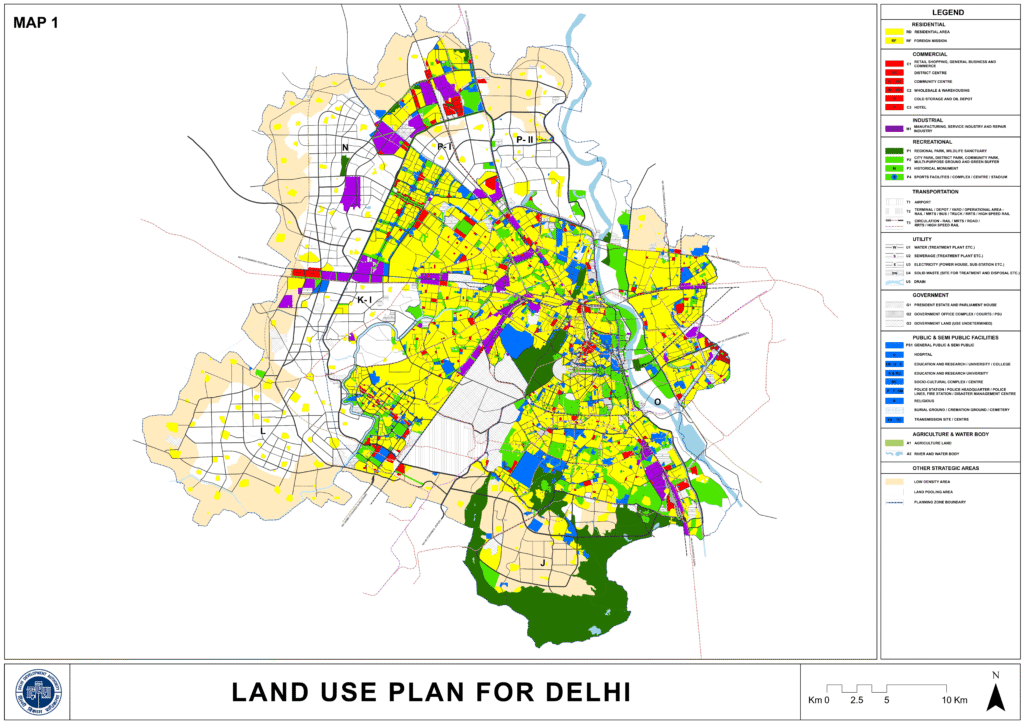
There’s a nod to the poorest, too. The plan says it will strengthen the “Jahan Jhuggi, Wahan Makaan” promise of permanent housing for jhuggi families, and push resident welfare associations to take up in-situ redevelopment of their own colonies.
Betting big on public transport in Delhi master plan 2047
This is where MPD-2047 gets interesting for anyone who cares about how Delhi actually moves. The metro is set to grow from around 416 km today to 695 km by 2047, backed by six new Regional Rapid Transit System corridors and more buses.
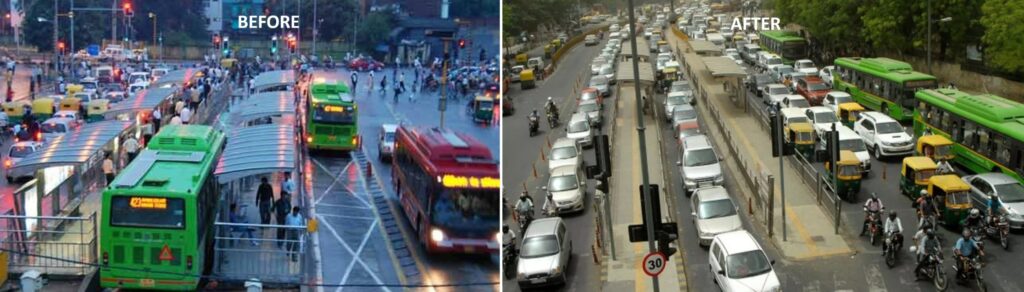
The plan leans heavily on Transit-Oriented Development, the idea that homes, offices and shops should cluster around stations so people can walk and take transit instead of driving everywhere.
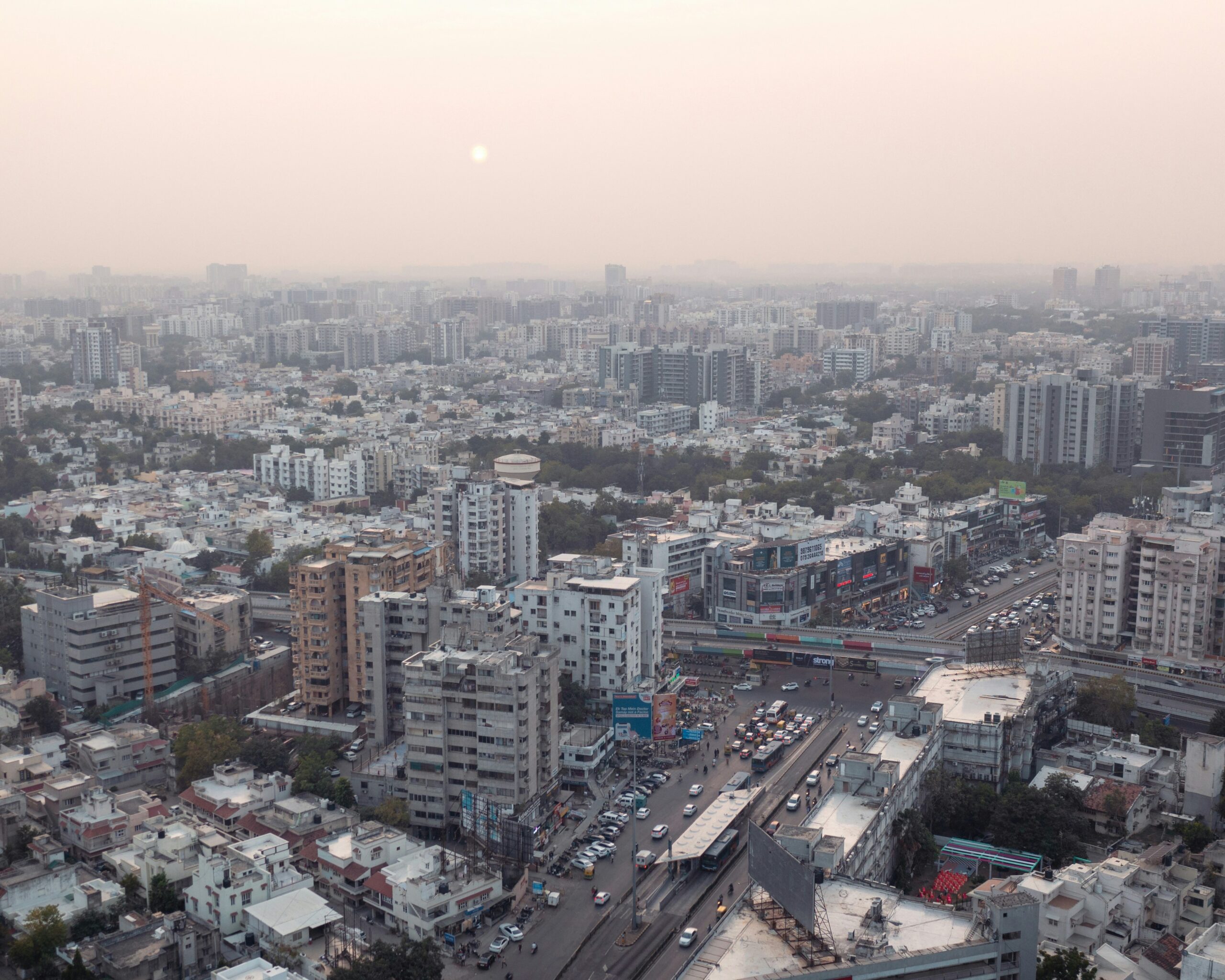
On paper, that is a genuinely people-first move. Whether Delhi builds walkable, shaded streets to match, or just tall towers next to gridlocked roads, is the part worth watching.
The green promise in the Delhi master plan 2047
About 22 per cent of Delhi is under green cover right now, and the plan wants to hold and strengthen that. It commits to protecting around 180 sq km of the Yamuna floodplains and the Ridge, and to knitting together a “green-blue” network of forests, biodiversity parks, drains and the river.
The infrastructure numbers are sobering. Sewage treatment capacity is meant to climb to about 1,285 MGD, and the city’s daily waste is projected to nearly double from about 13,500 tonnes to 25,764 tonnes a day by 2047. Building for more people also means building to manage a lot more of their waste.
The catch in Delhi master plan 2047
Here is the uncomfortable bit. India has a long history of ambitious master plans that read beautifully and then gather dust. MPD-2021 missed many of its own targets. A Gazette notification is a starting line, not a finish line.
MPD-2047 openly shifts Delhi from a “regulatory” approach to a “development-oriented” one — friendlier to investment and construction. That can unlock housing. It can also tilt the city towards whoever builds fastest.
The plan removes height restrictions across most of Delhi and allows a Floor Area Ratio as high as 400 in dense corridors. More floor space is only good news if roads, water, sewers and parks arrive alongside it. The plan promises exactly that link between construction and infrastructure. Holding it to that promise is the real work of the next twenty years.
For now, Delhi has a document that says the right things: transit, affordable homes, protected floodplains, a city for 3.2 crore people. The test, as always, is the street.
Read the plan yourself: Gazette notification (PDF) & DDA MPD-2047

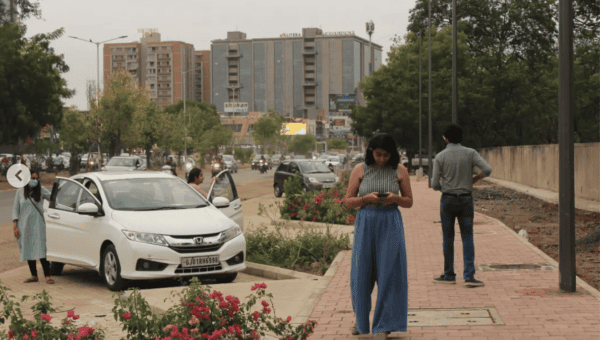



[…] guidelines, doesn’t spell out what a teenager needs to move safely. A researcher studying Delhi even coined a phrase for the gap – “walking dissonance” – where people walk […]