
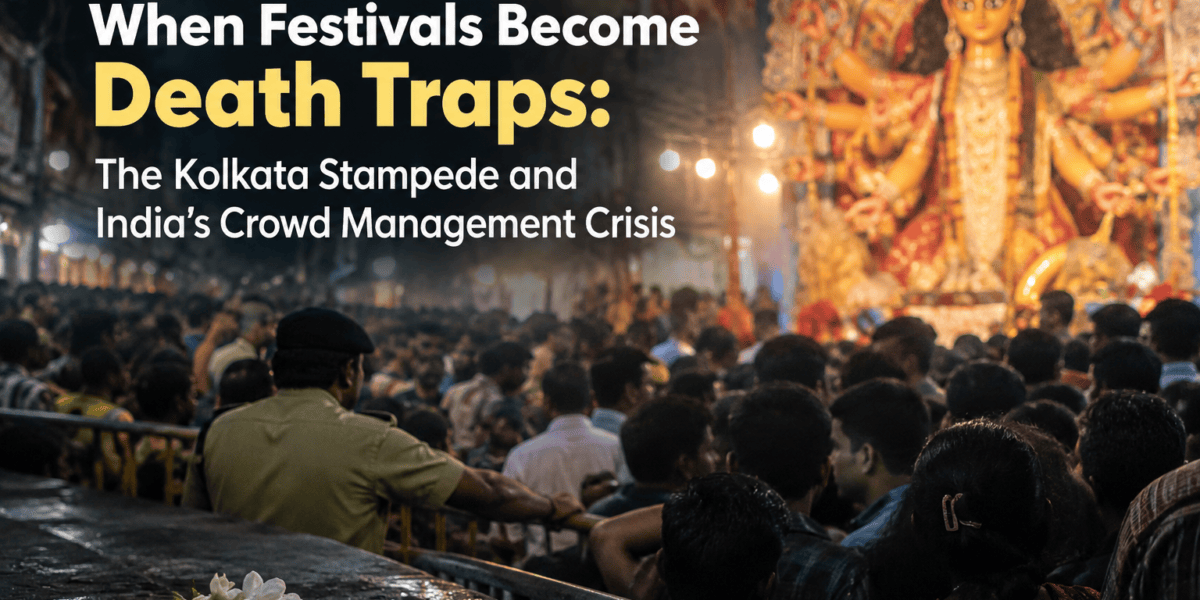
Kolkata : On the night of October 17, at least 19 people were killed and 25 injured in a stampede outside a Durga Puja pandal in Kolkata. Among the dead was a seven-year-old girl. Sudden rainfall sent thousands of people rushing simultaneously into a covered pavilion. The crowd compressed. People fell. By the time it was over, one of India’s most beloved festivals had become a crime scene.
The West Bengal government has announced a special task force probe. The Chief Minister’s office is monitoring the situation. Officials have described it as a tragedy caused by a “sudden influx of people.”
It was not sudden. It was entirely predictable.
A pattern that never changes
India has one of the worst records in the world for stampede deaths at public gatherings. Kumbh Mela 2025, 30 dead. Bengaluru cricket stadium 2026, 11 dead. And now Kolkata’s Durga Puja 2026 19 dead, and counting.
The causes are always the same: massive crowds, inadequate exits, poor communication systems, and a fundamental failure to apply basic crowd flow science to the design and management of public spaces. Rain — an entirely foreseeable weather event in October in Bengal — was enough to trigger a fatal crush.
The urban planning question nobody asks
Every post-stampede inquiry focuses on crowd management protocol — how many police were deployed, whether announcements were made on time, who gave the order to open the gates. These are the right questions to ask of event organisers. But they are the wrong questions to ask of cities.
The deeper question is this: why do Indian cities continue to design and permit public gathering spaces — pandal sites, temple courtyards, festival grounds — with no systematic attention to crowd dynamics, exit geometry, or emergency dispersal capacity?
Crowd safety science has existed for decades. Researchers like Professor Keith Still have developed internationally accepted standards for how many people can safely occupy a given space, how exits must be positioned, and how information must flow to prevent fatal crushes. These standards are applied routinely at large events in Europe, at the Hajj in Mecca, and increasingly at major sporting events in India itself.
They are almost never applied to the thousands of temporary festival sites that Indian cities permit every year.
What cities must do
The Kolkata tragedy demands more than a task force. It demands a fundamental rethinking of how Indian municipal authorities permit, design, and supervise mass gathering events not just the largest ones, but every pandal, every temple fair, every public celebration that draws thousands of people into a confined space.
At minimum, every permitted gathering above a threshold size should require a crowd safety assessment, certified exit capacity calculations, a real-time crowd monitoring plan, and a weather contingency protocol. These are not expensive requirements. They are the basic conditions for a city that takes its residents’ lives seriously.
Nineteen people went to celebrate Durga Puja last night. They did not come home. Their city failed them not in the moment the rain fell, but in every planning decision that left them with nowhere safe to go when it did.