
Bengaluru: By 2050, over 800 million Indians will live in cities. Yet, as urban India expands, basic urban services are under severe strain. From pothole-ridden, flooded roads to erratic water supply and mounting garbage, these are not isolated problems. They are a glaring symptom of a deeper, systemic challenge: Indian cities lack the financial resources to meet growing demands.
The World Bank estimates India needs to invest USD 840 billion in urban infrastructure between 2021 and 2036 — far more than cities currently spend.
A key reason for this financial shortfall lies in the weak performance of urban local governments (ULGs) — the frontline institutions responsible for running our cities — in raising revenues. According to data from www.cityfinance.in, on average, only about 55% of ULG revenues in India come from their own sources, an improvement over the years. While this marks a shift towards greater fiscal responsibility, a significant share of city finances still depends on state and central grants.
More importantly, even within own-source revenues, there remain deep inefficiencies in how taxes and user charges are assessed, billed, and collected—limiting the true revenue potential of cities.
Within own revenues, property tax remains the single largest, but still vastly underutilised, contributor. Across India, only about half of the billed demand is actually collected, and nearly one in three properties never even makes it to the tax register. This is money left on the table — money that could transform our cities.
Fixing the fundamentals of municipal revenues
Unlocking the full potential of property tax requires a three-pronged approach: (i) expanding coverage to ensure every taxable property is on the tax rolls, (ii) ensuring property valuations are in line with market realities, and (iii) improving collection efficiency through transparent and citizen-friendly payment systems. While valuation reforms often require state-level policy action, technology can play an immediate role in widening property tax coverage and improving collections.
Three ways technology can unlock municipal revenues
Widening the tax net
Every property leaves a trail — through sale deeds, electricity connections, or building approvals. Yet most of this information never reaches the municipal tax register because different government departments operate in silos. Each maintains its own database — registration departments record property transactions, electricity utilities maintain connection records, while town planning departments track building permissions. These datasets are often far more comprehensive than municipal property tax records, but the lack of coordination means valuable information is lost.
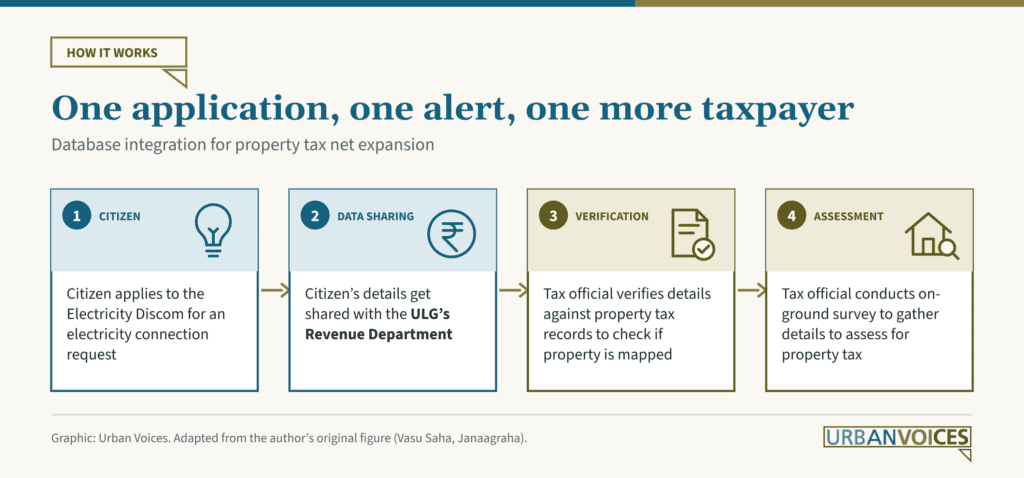
The fix is integration. With automated data sharing, every time a citizen registers a property or applies for an electricity connection, the ULG gets an instant alert to check if the property is already in the tax register.
States like Andhra Pradesh, Assam, Haryana, Karnataka and Telangana have already taken steps to link property tax databases with registration departments, electricity discoms and other government datasets. These efforts point to an important shift: instead of relying solely on periodic surveys and manual identification, ULGs can use existing administrative data to maintain more complete and up-to-date tax registers.
The benefits extend beyond revenue mobilisation to ease of doing business for citizens. For instance, when a property changes ownership through a registered sale deed, the information can be shared with the municipality to update ownership records and initiate mutation, reducing the need for citizens to submit the same documents to multiple departments. Such integration can make property transfers more seamless while helping ULGs maintain accurate tax records and ensure that tax liabilities are updated promptly.
Making tax reminders smarter, a behaviour change nudge
Identifying a taxpayer is only the first step. Cities must also ensure that taxpayers know what they owe and can be encouraged to pay on time. Most of us routinely receive mobile, electricity and other utility bills on our phones, along with payment reminders and instant confirmations. Property tax systems, however, often continue to rely on delayed bill distribution, physical follow-ups and manual collection drives. Staff shortages make these exercises particularly difficult to sustain across large urban populations.
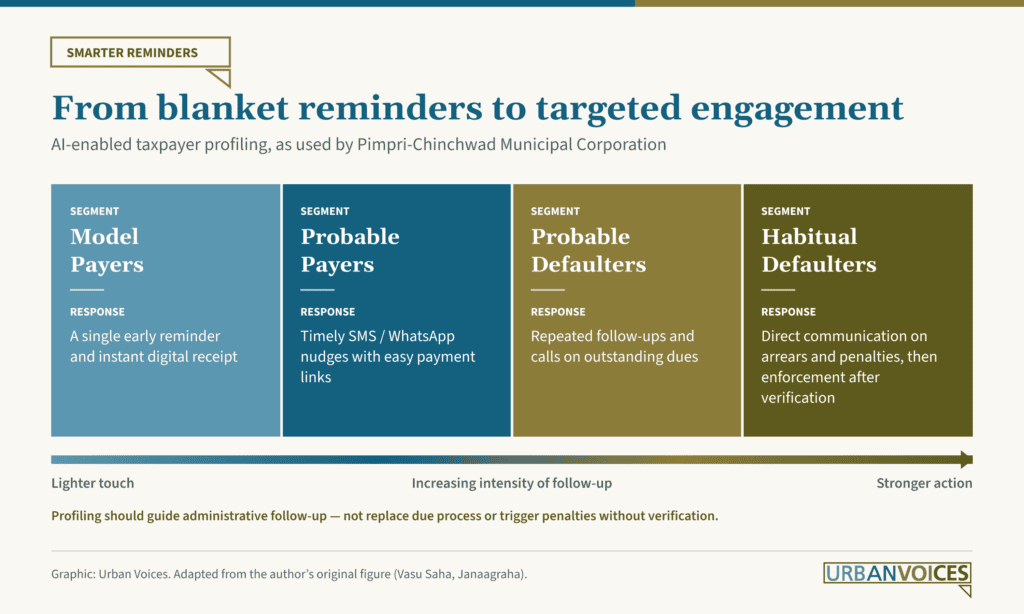
Technology can help municipalities move from blanket reminders to more targeted engagement. Pimpri-Chinchwad Municipal Corporation (PCMC), for instance, uses AI-enabled taxpayer profiling to classify taxpayers according to past payment behaviour, including categories such as Model Payers, Probable Payers, Probable Defaulters and Habitual Defaulters. Tailored SMS messages and calls can then be used to encourage payment, rather than treating every taxpayer in the same way.
Similarly, cities such as Chennai, Hyderabad and Ranchi have introduced WhatsApp-based chatbots that allow citizens to check outstanding dues, pay taxes and receive instant receipts, with services available in regional languages. By bringing municipal services onto familiar messaging platforms, these tools make it easier for citizens to access information and fulfil their tax obligations without visiting municipal offices.
The approach is straightforward: a taxpayer who usually pays on time may need only an early reminder, while someone with a history of delayed payments may require repeated follow-ups or more direct communication about outstanding dues, and information on applicable penalties for late payment. Combining targeted reminders with accessible digital services can make compliance easier for citizens while helping municipalities improve collection efficiency.
Making payments effortless
Even when taxpayers are correctly assessed and reminded, cumbersome payment processes can discourage timely compliance. Long queues, restricted payment options and complicated procedures create unnecessary friction.
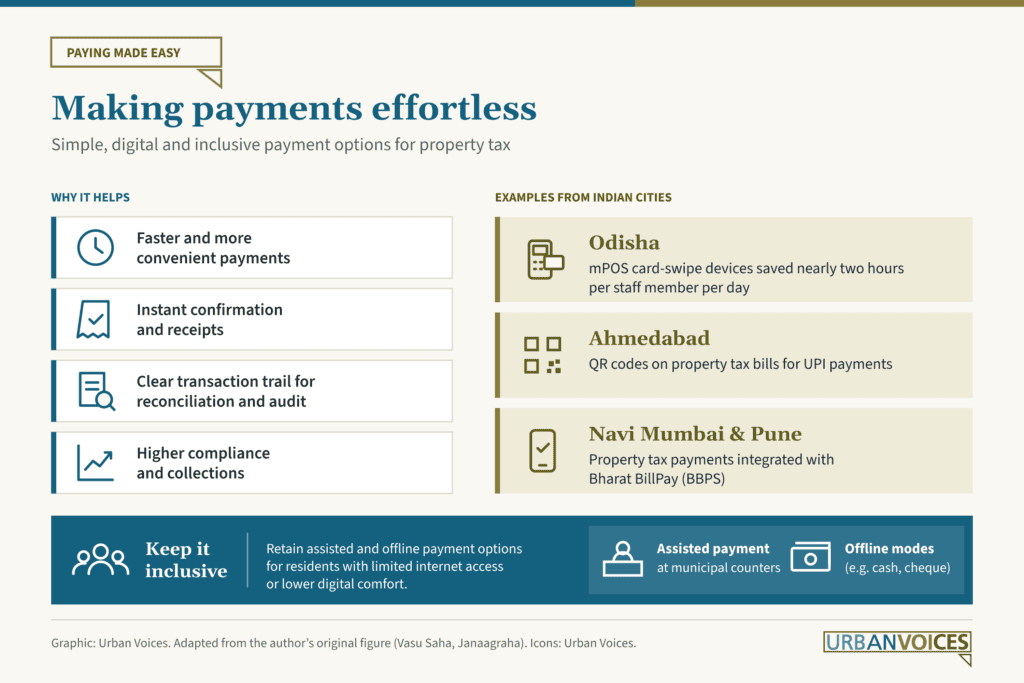
Digital payments can make compliance simpler. Odisha’s rollout of mPOS card-swipe devices saved nearly two hours per staff member per day previously lost to manual data entry.
Ahmedabad has introduced QR codes on property tax bills to facilitate UPI payments, while cities such as Navi Mumbai and Pune have integrated property tax payments with Bharat BillPay (BBPS), enabling citizens to use familiar bill-payment channels.
These innovations matter because convenience influences behaviour. When taxpayers can pay from their phones, receive instant confirmation and access their payment history without visiting a municipal office, the cost—in time and effort—of compliance falls.
Digital payments also create a clearer transaction trail, improving the scope for reconciliation, audit and accountability. However, cities must retain assisted and offline payment options for residents who lack reliable internet access or are less comfortable with digital services. The objective should be to make payment easier for everyone, ensuring that technology reduces barriers to compliance rather than creating new ones for citizens with limited digital access.
Beyond pilots: A national blueprint for cities in India
India has demonstrated that technology can make municipal revenue administration more efficient. The next challenge is to move from isolated city-level initiatives to systems that can be replicated across thousands of urban local governments. This requires more than digitising records or launching payment apps.
First, mandate data sharing.
States should require property registration departments, electricity distribution companies and town planning authorities to share relevant property data with ULGs through standardised APIs and clear protocols. Rules should specify data fields, update frequency, and privacy safeguards, rather than leaving integration to city-level negotiations.
Second, build once, reuse everywhere.
Successful digital solutions should not have to be reinvented by every city. Pimpri-Chinchwad’s AI-enabled taxpayer profiling offers a model that other ULGs can adapt to improve taxpayer targeting and collection efficiency. The Ministry of Housing and Urban Affairs (MoHUA) could facilitate this through a national platform for sharing best practices, peer learning and knowledge exchange, enabling cities to learn from one another’s experiences. States and the MoHUA should also support shared, interoperable digital platforms and reusable software modules that municipalities can adopt at low cost. This would reduce duplication, lower technology costs and help smaller ULGs with limited financial and technical capacity replicate proven innovations.
Third, turn data into better compliance.
Integrating databases is only the first step; municipalities must act on the discrepancies they uncover. Digital systems should flag potentially unassessed properties, identify outstanding arrears and prioritise follow-ups based on payment history and dues. These flags should trigger a structured workflow—from verification and reminders to enforcement under applicable rules. This would help cities translate better information into actual revenue gains rather than allowing digital records to remain underutilised.
Fourth, build the capacity to sustain digital reforms.
Technology investments often falter when municipalities lack trained personnel, technical support or funds for ongoing maintenance. States should establish dedicated support units to help ULGs adopt and maintain shared platforms, train revenue staff to use digital tools, and provide funding for software, hardware, data digitisation and recurring costs such as maintenance and cybersecurity. Assisted and offline payment channels must also remain available to ensure that digitalisation does not exclude citizens with limited digital access.
Finally, technology must strengthen, not undermine, public trust.
Taxpayers should be able to verify their assessments, correct inaccurate records and access effective grievance redressal. Automated profiling should guide administrative follow-up, not replace due process or result in penalties without verification. Transparent assessments and accessible payment channels are essential to ensure that digitalisation makes compliance easier and fairer for all citizens.
Ultimately, the goal is not merely to digitise municipal tax administration, but to help cities mobilise the resources they need to deliver better services to their citizens.