
Tucked between the Purna River and the emerging industrial corridors of South Gujarat, Navsari has long been a city overshadowed by its giant neighbour, Surat. But 2025 changed that calculus in a fundamental way. On January 1, 2025, the Gujarat government elevated Navsari from a Nagar Palika (municipality) to a full-fledged Mahanagarpalika (Municipal Corporation), one of nine newly created urban bodies in the state and, with it, appointed the city’s first-ever Municipal Commissioner: IAS officer Dev Choudhary
How Commissioner Dev Choudhary is steering Gujarat’s newest municipal corporation toward smarter, greener, and more people-friendly streets
The move was not merely administrative. It was a signal that Navsari, with its growing industrial base, textile linkages, and proximity to the Surat Economic Development Hub, is being groomed as a serious urban centre. And at the heart of this transformation lies a question that cities across India are grappling with: how do you move people efficiently, equitably, and sustainably in a fast-growing Tier-2 city?
A City Upgraded, A Budget Supercharged
The elevation of Navsari’s municipal status has had immediate and measurable financial consequences. The city’s annual budget has grown to ₹850 crore, a leap made possible by the new corporation status and supported by a ₹284 crore grant disbursed directly from the Gujarat Municipal Finance Board on the day of inauguration in November 2025.
Shortly after taking over, the Navsari Municipal Corporation (NMC) announced a ₹475-crore package of urban development projects — including road network upgrades, multi-level parking, strengthened drainage, a modern town hall, and improved civic infrastructure — unveiled during CM Bhupendra Patel’s first visit to the city in his new capacity as head of a corporation.
The scale of ambition is steep. But so is the urgency: four villages — Eru, Dharagiri, Dantej, and Hansapore — were merged into the new corporation’s jurisdiction, bringing with them thousands of residents who had long been underserved by urban infrastructure.
The Man at the Helm: Dev Choudhary, IAS
Dev Choudhary comes to Navsari from the Ahmedabad Municipal Corporation, where he served as Deputy Municipal Commissioner in the North West Zone, one of the country’s most urbanistically complex municipal environments. A science graduate with a Master’s degree in Public Management, Choudhary is among the cohort of IAS officers from the 2016 Gujarat cadre now taking on leadership roles in the state’s newly minted urban bodies.
Navsari’s Municipal Corporation website lists him as the city’s founding commissioner, a distinction that carries weight. (NMC Official Website)
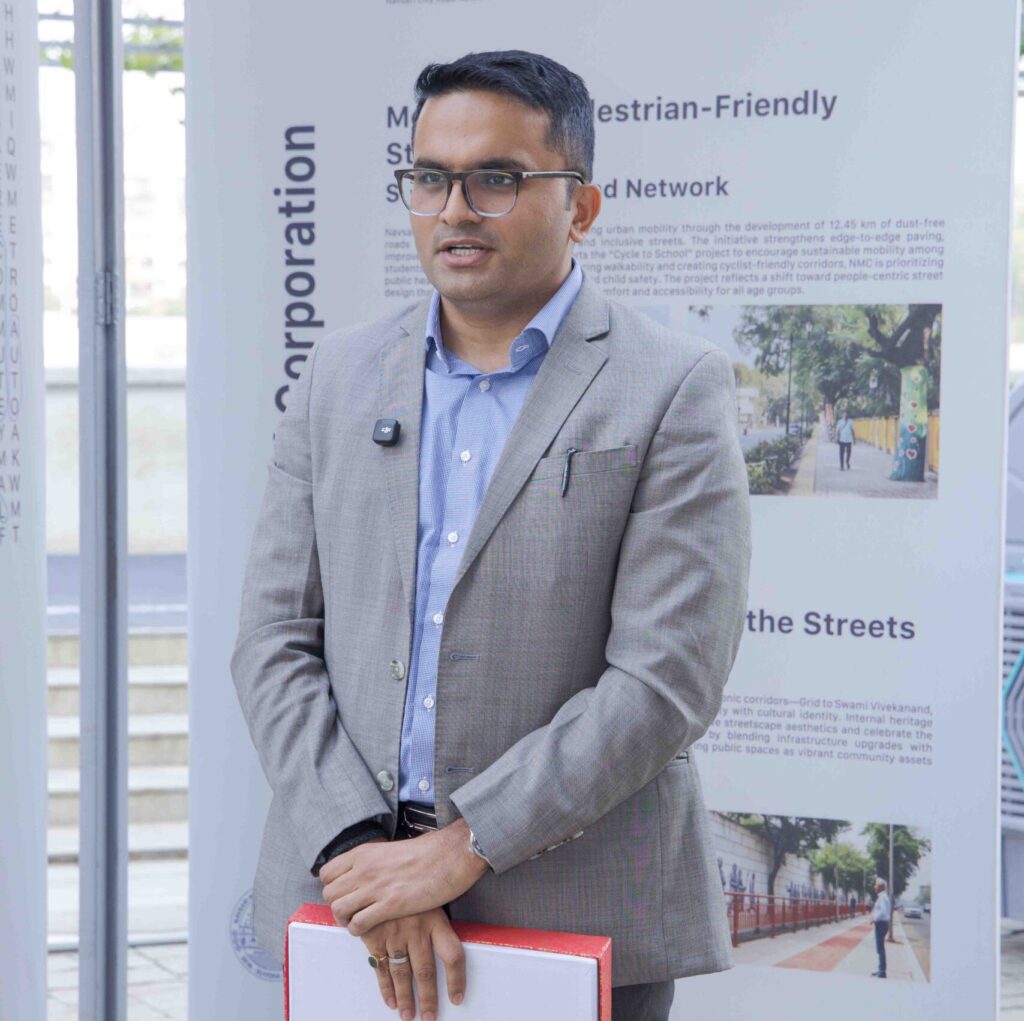
In one of his first public statements on urban priorities, Choudhary was direct about the foundation-laying needed in the expanded city. “In the new year, Navsari Municipal Corporation is focusing on improving basic civic facilities, including drainage, roads, storm water systems, and water supply,” he said, announcing a ₹112-crore water and drainage network project to serve the four newly integrated villages. “The project is being implemented on schedule and will provide relief to residents while improving their overall well-being.”
What is significant is not just the infrastructure pipeline but the sequencing. Choudhary’s team moved on road resurfacing tenders (worth ₹5 crore) within weeks of NMC’s formation, according to the corporation’s own social media updates. He has also floated an Expression of Interest (EoI) for establishing an Integrated Command and Control Centre (ICCC) in Navsari, a digital nervous system for the city that would integrate traffic management, public transport, and civic services under one roof.
The Bus Port: A Symbol of Shifting Priorities
The most visible symbol of Navsari’s transport transformation arrived on November 25, 2025, when Chief Minister Bhupendra Patel inaugurated the city’s new GSRTC Bus Port, the 13th such modern facility in Gujarat, and arguably the most symbolically charged.
Built across 5,025 square metres at a cost of ₹82 crore under the Public-Private Partnership (PPP) model, the Navsari Bus Port is designed to function less like a bus stand and more like an airport terminal with deluxe waiting lounges, RO drinking water, departmental stores, a canteen, wheelchair access for differently-abled passengers, and comprehensive CCTV surveillance.
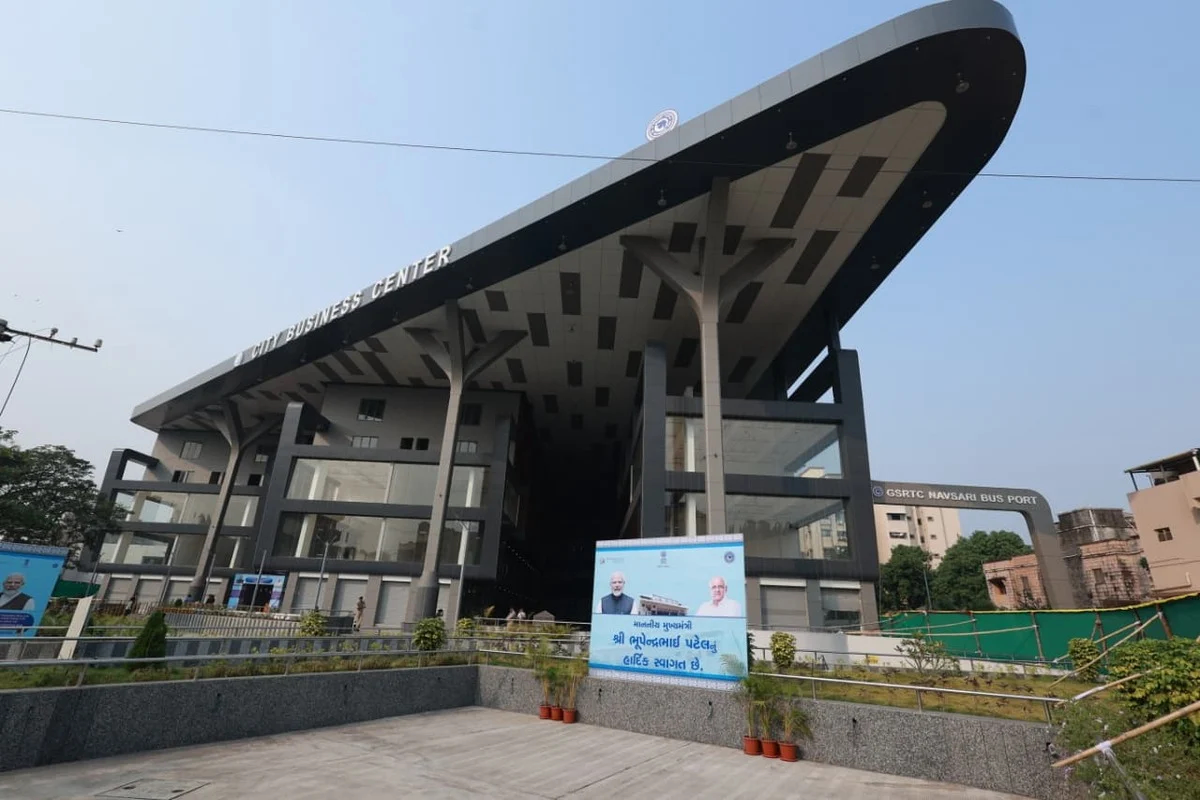
The project is part of the Gujarat State Road Transport Corporation (GSRTC)’s state-wide programme to convert traditional bus stations into integrated public utility hubs. Larger cities are going further, adding cinemas, banquet halls, and shopping complexes to their bus ports, turning them into economic anchors rather than mere transit points. In Navsari’s case, the bus port marks a deliberate reorientation of the city’s public face: if you arrive by bus, you are not second-class.
Seven New Routes and the Last-Mile Gap
A city’s transport ambition, however, cannot rest on a single landmark building. The real test lies in the network, the daily dance of buses, routes, frequencies, and fares that determines whether people actually leave their two-wheelers at home.
On this front, Navsari received a significant push in April 2026, when the Gujarat government approved 17 new urban bus routes across three cities under the Chief Minister’s Urban Bus Service Scheme. Of these, seven routes were sanctioned exclusively for the Navsari Municipal Corporation, the largest share of any city in the announcement, with the explicit goal of connecting different parts of the expanding city and its newly merged peripheral areas.
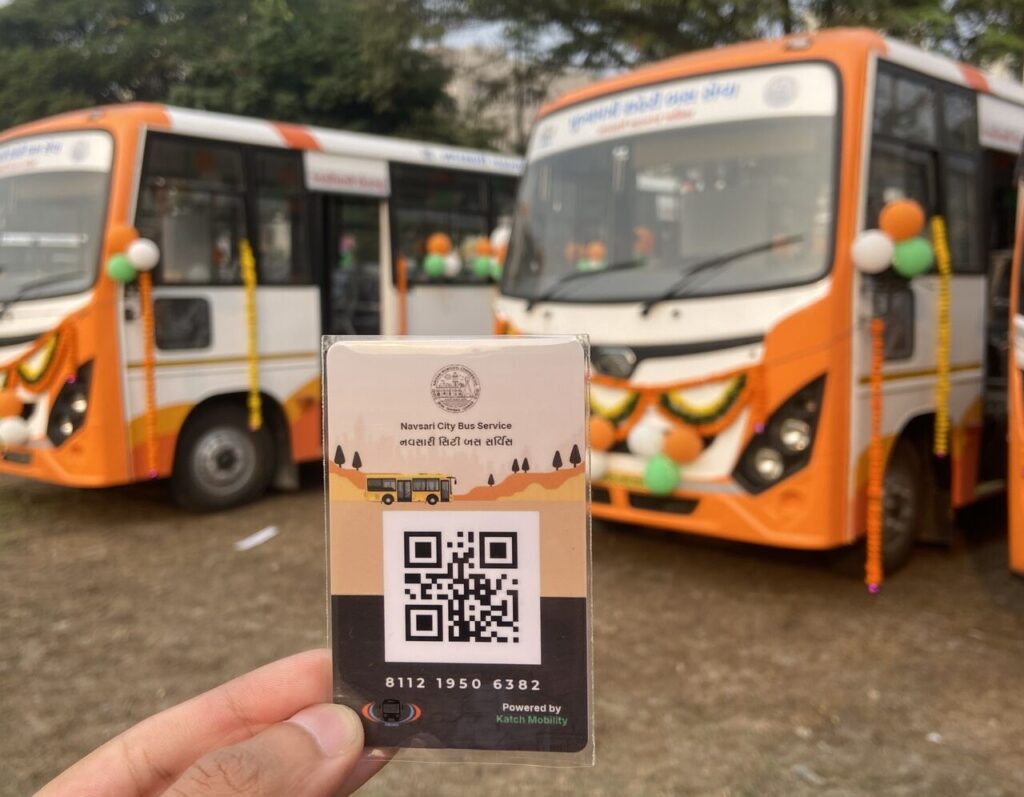
Deputy Chief Minister Harsh Sanghavi, clearing the proposal, said the scheme’s “primary objective is to make daily travel more convenient and time-efficient.” Navsari’s seven routes are designed to serve residents who currently rely on overloaded shared autos or private vehicles for intra-city movement.
The city also has a dedicated Navsari City Bus Service app (NMBS) available on Android and iOS, offering real-time bus tracking, route information, and online ticketing. This digital layer signals intent to build a user-friendly public transport ecosystem.
Separately, 793 CNG buses are being approved across 12 Gujarat cities, including Navsari, as part of the state’s urban transport modernisation push, replacing ageing fleets and adding new vehicles to city bus services.
The NMT Question: Streets for People, Not Just Vehicles
Public transport improvements mean little if the streets around bus stops and transit nodes are hostile to pedestrians. This is where Non-Motorised Transport (NMT), walking, cycling, and accessible footpaths become central to any serious urban mobility strategy.
Navsari, like most Indian cities of its size, has historically underinvested in NMT infrastructure. Footpaths are intermittent, cycle tracks non-existent, and road designs prioritise vehicular throughput over pedestrian comfort. The merged villages now within NMC’s jurisdiction have even fewer amenities: no footpaths, limited street lighting, and drainage systems that flood during the monsoon.
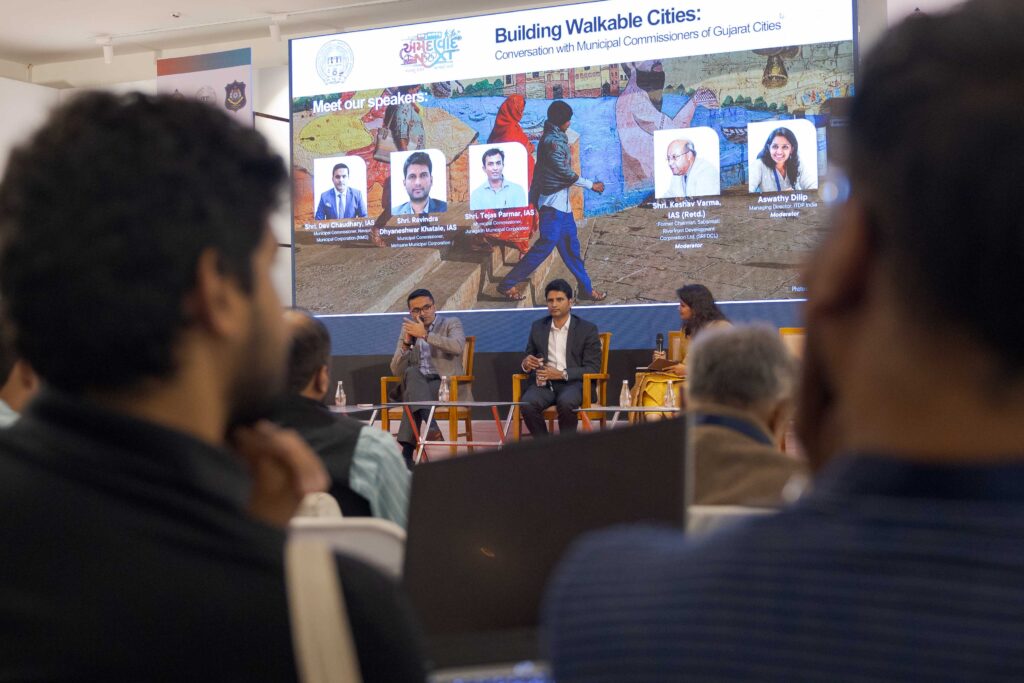
The ₹475-crore development package includes upgraded road networks as a priority, and the expanded project list for the merged villages specifically includes better roads, street lighting, gardens, ponds, and civic centres. These are not merely cosmetic additions; properly designed streets with footpaths, shade trees, and good lighting are the backbone of walkability in a tropical city.
Commissioner Dev Choudhary’s stated emphasis on roads and drainage in the first phase of NMC’s work lays the physical groundwork for safer walking environments. The ICCC project, if realised, would enable real-time monitoring of street conditions, signal timings, and traffic hotspots, creating the data infrastructure necessary for intelligent NMT planning.
National benchmarks are instructive here. Chennai’s Greater Corporation, which adopted India’s first NMT Policy in 2014, mandated that 60% of its transport budget go to walking and cycling infrastructure. In 2025–26, Chennai committed ₹200 crore for 170 km of high-quality footpaths. (ITDP India, September 2025) For Navsari to follow a comparable trajectory, NMC would need to embed NMT standards into its road construction and resurfacing contracts from the outset, before patterns of vehicle-centric design become entrenched.
The Industrial Pressure: PM MITRA and the Mobility Multiple
Navsari’s transport planning cannot be viewed in isolation from its industrial ambitions. The city is part of the Surat Economic Development Hub, and is home to a 1,142-acre PM MITRA (Mega Integrated Textile Regions and Apparel) Park in Vansi Borsi village, for which PM Modi laid the foundation stone in February 2024, and whose final Detailed Project Report (DPR) was approved in December 2025.
When this park becomes operational, it will generate large-scale daily movement of workers — many of them from lower-income households who depend entirely on public transport and non-motorised modes. Every bus route, every safe footpath, every cycle track becomes a direct economic enabler. Workers who cannot reach their jobs efficiently are workers who cannot participate in economic growth.
The lesson from India’s textile cities is consistent: where public transport and NMT infrastructure follow industrial investment, productivity and quality of life both rise. Where they lag, the costs are borne disproportionately by those least able to bear them.
What Navsari Needs Next
Commissioner Choudhary’s first year in office has been defined by the urgency of foundational infrastructure, water, drainage, roads, and the administrative machinery of a new corporation. This is the right priority sequence: you cannot build walkable streets on crumbling drains.
But the window for getting mobility right is narrow. Road-widening and resurfacing projects, if undertaken without NMT provisions, lock cities into car-centric patterns for decades. The street designs being approved today in Navsari will shape how millions of people move in 2035.
For Navsari to become a model Tier-2 city in Gujarat’s urban development story, the next phase must include:
- Mandatory footpath norms in all road construction and resurfacing contracts under the ₹475-crore development programme
- A dedicated NMT policy or street design guidelines at the NMC level, building on the national Urban Street Design Guidelines (MoHUA, 2021)
- Integration of bus stops with safe pedestrian access — ensuring the new routes and the new bus port are connected by walkable streets, not just marked on a map
- Cycle tracks and safe crossings on key corridors, especially routes connecting the bus port, railway station, markets, and educational institutions
- Last-mile connectivity from bus stops to the PM MITRA park and industrial zones, so that the city’s working-class commuters can actually benefit from expanded bus services
- ICCC integration with traffic and pedestrian data to monitor and enforce safe NMT conditions
Navsari Can Set A New Benchmark in Making “City For People”
Navsari has never had a more important moment for urban leadership. A new Municipal Corporation. A new Commissioner. A new ₹850-crore annual budget. Seven new bus routes. A ₹82-crore modern bus port. A ₹112-crore civic infrastructure project. A 1,142-acre industrial park on the horizon.
Dev Choudhary’s appointment as Navsari’s first Municipal Commissioner places him in rare company: the administrators who get to write the first chapter of a city’s corporate-era governance story. The choices made in these early years — on road design, on public transport investment, on whether footpaths get built — will echo for generations.
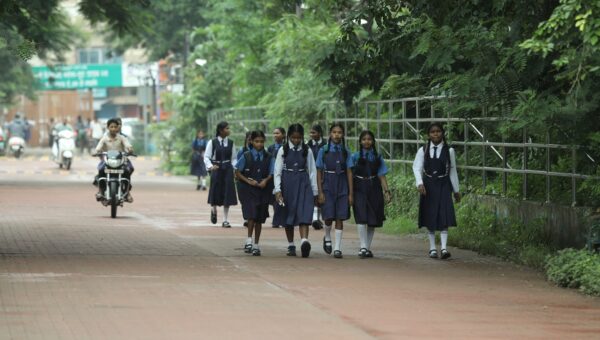
Navsari has the institutional infrastructure, the financial momentum, and the political backing to get this right. What it needs now is a deliberate, explicit commitment to streets that work for everyone: the pedestrian, the cyclist, the bus commuter, the school child, the factory worker. That commitment, embedded into NMC’s project contracts and planning regulations from the ground up, would be Dev Choudhary’s most lasting legacy as Navsari’s founding commissioner.