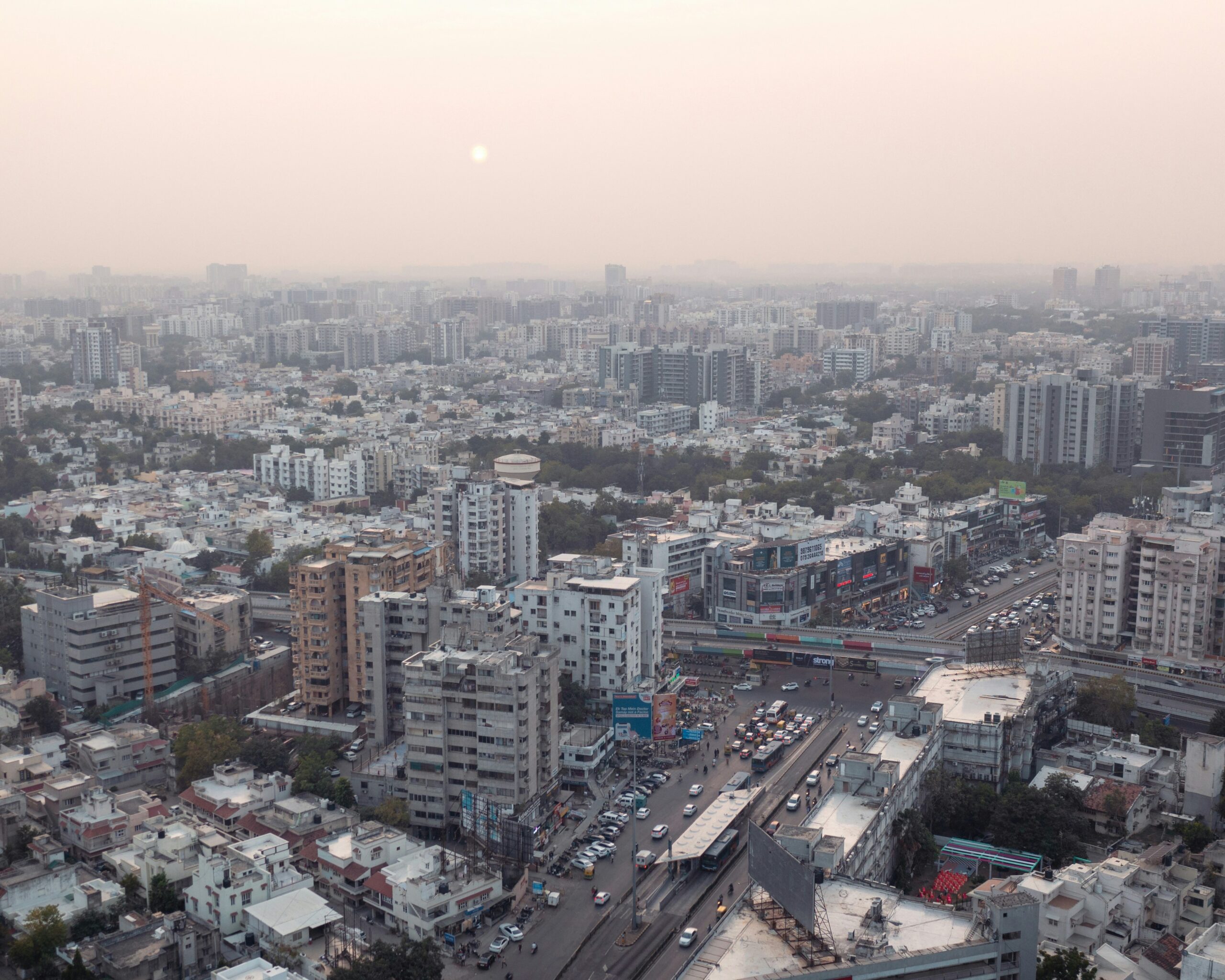

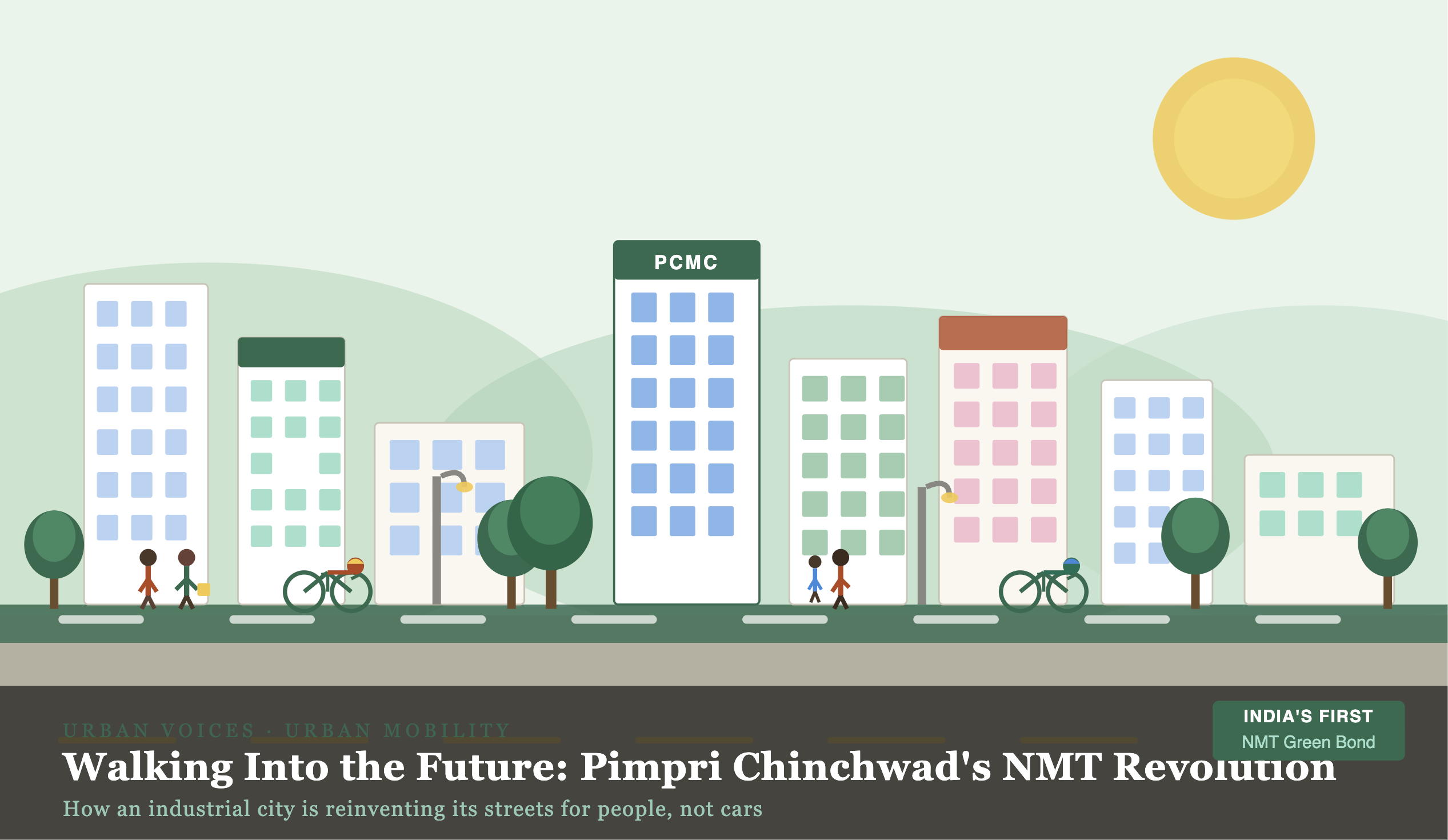
In one of India’s fastest-growing industrial cities, a quiet revolution is underway on footpaths, cycle tracks, and shaded boulevards. Can Pimpri Chinchwad become a blueprint for how Indian cities move? Drive through the industrial sprawl of Pimpri Chinchwad on a Monday morning, and the sheer scale of the city’s mobility crisis is impossible to miss. Over 21 lakh registered vehicles compete for space on roads designed for a fraction of that volume.
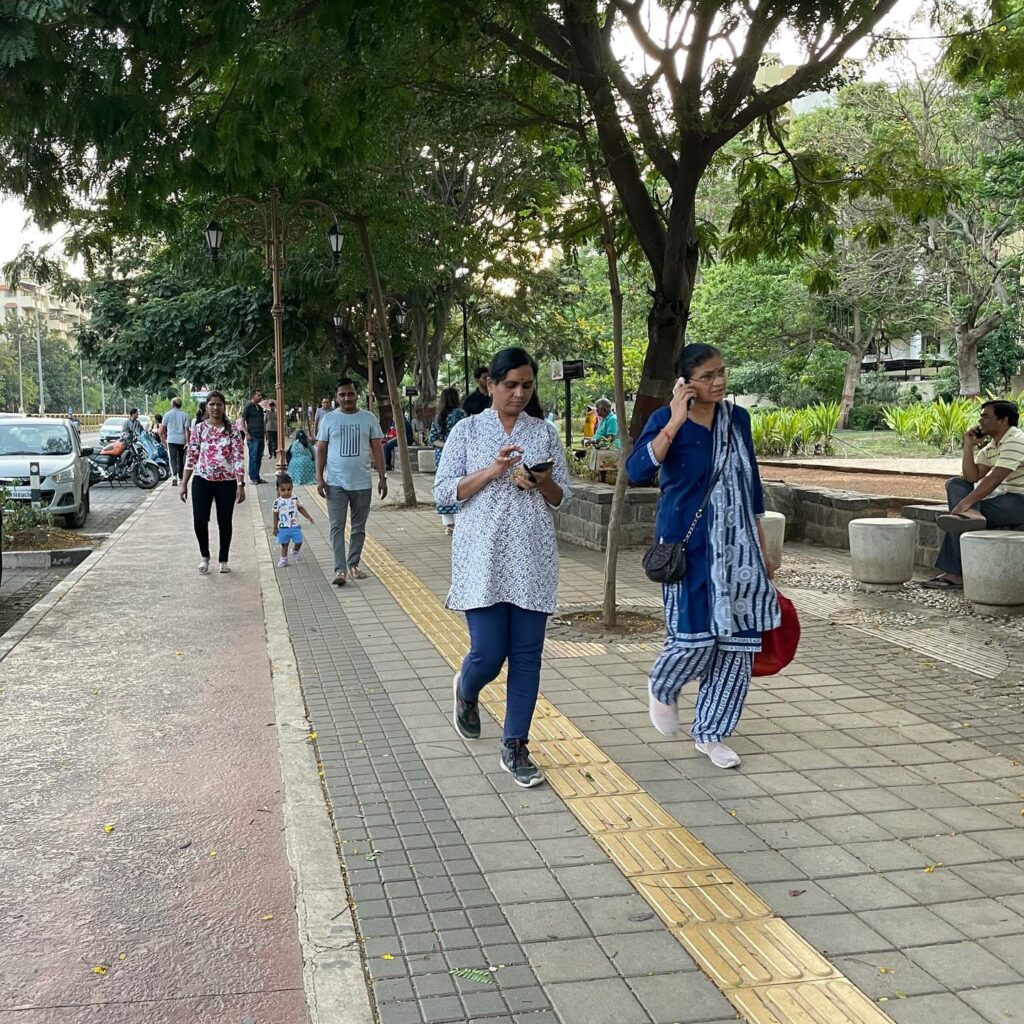
The air hangs heavy. Footpaths, where they exist, are often an afterthought, cracked, encroached upon, or simply absent. And yet, step into the Pradhikaran neighbourhood today, and you encounter something startlingly different: shaded pedestrian walkways, painted cycle lanes, tree-lined streetscapes, and children walking safely to school. This is not a mirage. It is the early fruit of one of the most ambitious non-motorised transport (NMT) programmes an Indian city has ever attempted.
- 90% Target trips by walking, cycling & public transport by 2036
- ₹200 cr India’s first municipal Green Bond for NMT
- 55 % of the transport budget is towards Sustainable Transport in PCMC (2024)
Pimpri Chinchwad Municipal Corporation (PCMC) has, over the last decade, quietly assembled a policy architecture that most Indian cities can only aspire to. The question now being asked by planners, urbanists, and citizens alike is whether the ambition on paper can keep pace with the transformation on the ground.
As Commissioner of Pimpri Chinchwad Municipal Corporation (PCMC) since August 2022, IAS officer Shekhar Singh has spearheaded sustainable urban mobility, notably through the Harit Setu Master Plan and robust Non-Motorised Transport (NMT) initiatives. He prioritises cycling, walking, and public transit (BRTS) to combat congestion over road widening, aiming to build a sustainable and inclusive city
A City That Outgrew Its Roads
Pimpri Chinchwad is no ordinary tier-2 city. Often described as Pune’s industrial twin, it hosts the Pimpri industrial belt, a dense concentration of automobile factories, engineering firms, and pharmaceutical plants, making it one of Maharashtra’s most economically vital urban centres.
Its population has crossed 24 lakh, and with nearly 90 vehicles per 100 residents, it ranks among India’s most motorised cities by density. Traffic congestion, deteriorating air quality, and road safety have become existential concerns rather than manageable inconveniences.
The vehicle-to-human ratio is telling. The city’s vehicle population of over 21 lakh (as of 2024) is racing to match that of its human residents, with no sign of slowing down. Every new flyover and grade separator built to ease traffic adds, paradoxically, to the city’s long-term congestion burden by inducing more private vehicle usage, a well-documented phenomenon in transport planning that PCMC has begun to openly acknowledge.
What Is NMT?
Non-Motorised Transport (NMT) refers to all modes of travel that do not rely on a motor engine — primarily walking and cycling. In urban planning, NMT infrastructure includes footpaths, cycle tracks, pedestrian crossings, safe school zones, and public bicycle sharing systems. When integrated with public transport, NMT dramatically reduces private vehicle dependency.
Policy Foundations: Building the Architecture
PCMC’s NMT transformation did not emerge overnight. It is the product of a decade-long sequence of policy decisions that have slowly embedded sustainable mobility into the city’s institutional DNA.
- Year 2018- PCMC adopts its Parking Policy — one of India’s few structured municipal approaches to on-street parking management, aiming to reduce car dependency through pricing and enforcement.
- Year 2018- The Pune Metropolitan Region’s Comprehensive Mobility Plan (CMP) sets a metropolitan-level vision for sustainable transport, embedding walking and cycling into regional planning for the first time.
- Year 2021-PCMC formally adopts its landmark Non-Motorised Transport Policy — a first for the Pune region — committing to 90% of all trips being made by walking, cycling, or public transport by 2036, and targeting an 18% reduction in private vehicle trips.
- Year 2022- The Urban Streetscapes Programme (USP) and Harit Setu Masterplan move from drawing board to active implementation, beginning the physical transformation of streets.
- Year 2024- PCMC becomes the first city in India to issue Green Bonds for NMT — raising ₹200 crore to fund walking and cycling infrastructure directly.
- Nov 2025PCMC receives the Award of Excellence in Urban Transport from the Ministry of Housing and Urban Affairs at the National Urban Mobility Conference in New Delhi.
What makes this sequencing significant is not just the policies themselves, but the institutional intent behind them. PCMC has recognised, perhaps better than most Indian cities, that infrastructure alone is fragile it must be anchored by policy frameworks that survive changes in political leadership and bureaucratic priorities. The NMT Policy’s measurable targets are a deliberate tool for accountability, giving civil society and technical partners a benchmark against which to hold the city.
Harit Setu: Connecting Greens Through Streets
The centrepiece of PCMC’s NMT vision is the Harit Setu Masterplan — literally, “green connectivity.” The concept emerged from a candid acknowledgement of an early failure: while the city had invested in standalone streetscape projects, these improvements were not forming a coherent, connected network for pedestrians or cyclists. A well-designed footpath that ends at an arterial road, with no safe crossing, is of limited use to a daily commuter.
Harit Setu is designed to close these gaps — creating a city-wide network of green corridors that link neighbourhoods, schools, transit stops, and open spaces through continuous walking and cycling infrastructure.
The pilot implementation in the Pradhikaran neighbourhood covers 17 km of streets in the Nigdi-Pradhikaran area, and has already yielded striking results. Post-development surveys found that citizens, particularly women and children, now describe these streets as significantly safer and more comfortable to use.
Demand from residents and local elected representatives to replicate the model citywide has been immediate.
“By 2036, Pimpri Chinchwad aims to make short-distance travel possible by walking or cycling, and long-distance commutes accessible by public transport.” Bapu Gaikwad, Joint City Engineer, PCMC
The features embedded in Harit Setu streets read like a checklist of international best practice: shaded pedestrian walkways, dedicated cycle tracks, safe school zones, cycle parking, rainwater harvesting channels, tree plantation drives, improved street furniture, and legible signage. The Telco Road redevelopment, one of PCMC’s showcase projects completed under Green Bond funding, demonstrates what a transformed arterial street can look like in an Indian industrial city.
Green Bonds: A Financial First
Perhaps the most consequential innovation in PCMC’s NMT programme is not infrastructural but financial. In 2024, the city became the first municipality in India to raise Green Bonds specifically for non-motorised transport, mobilising ₹200 crore from capital markets to fund Harit Setu and Telco Road projects. This is not a trivial distinction. Municipal bodies across India routinely struggle to fund sustainable mobility projects, often because these investments do not generate the direct revenue that capital markets typically seek.
PCMC’s Green Bond issuance signals that walking and cycling infrastructure can be structured as a credible, marketable asset — a model that other Indian cities are now watching closely.
The Additional Commissioner of PCMC, Vijaykumar Khorate, described the approach as “self-reliant” financing that ensured timely project delivery without dependency on central government grants that are uncertain in timing and conditionality.
The Budget Picture: Ambition Meets Arithmetic
Numbers, in urban governance, reveal commitment more honestly than policy documents. PCMC’s transport budget for 2024-25 was ₹1,475 crore — approximately 17% of its total municipal budget of ₹8,676 crore. Of this, the NMT allocation stands at ₹439.7 crore, representing 31% of the transport budget and one-third of all transport spending — a figure that ITDP India, which has analysed urban transport budgets across Indian cities, describes as the highest NMT share of any major Indian city.
The growth in NMT allocation is equally striking: PCMC more than doubled its NMT budget from ₹217.9 crore in 2023-24 to ₹439.7 crore in 2024-25. Compare this with Pune, the adjoining city that shares PMPML bus services and metro infrastructure with Pimpri Chinchwad — Pune allocated only 15% of its transport budget to NMT, with no dedicated cycle track funding at all in 2024.
Beyond municipal funds, PCMC has also channelled ₹262.5 crore through its Urban Transport Fund (UTF), of which nearly half was dedicated to NMT and public transport. Central scheme money from NCAP (National Clean Air Programme) added a further ₹23 crore for NMT-friendly streets, and 15th Finance Commission funds contributed ₹42 crore for last-mile metro connectivity.
The Gaps That Remain
Only 5% of PCMC’s streets have been transformed: so far (approximately 110 km of the total network). To meet its 2036 targets, the city must build 25 km of improved streets annually and consistently sustain ₹200–250 crore in annual street development spending.
Car-centric projects still dominate: Despite progress, 58% of PCMC’s transport budget continues to go towards vehicle-centric infrastructure such as grade separators and road widening, investments that provide temporary congestion relief but worsen car dependency long-term.
The bus deficit is severe: PCMC currently operates 31 buses per lakh population. The MoHUA benchmark is 60 buses per lakh. Without a dramatically expanded bus fleet, the vision of 90% sustainable trips remains structurally incomplete; walking to a bus stop that has no bus defeats the purpose.
Streets as Public Space, Not Just Infrastructure
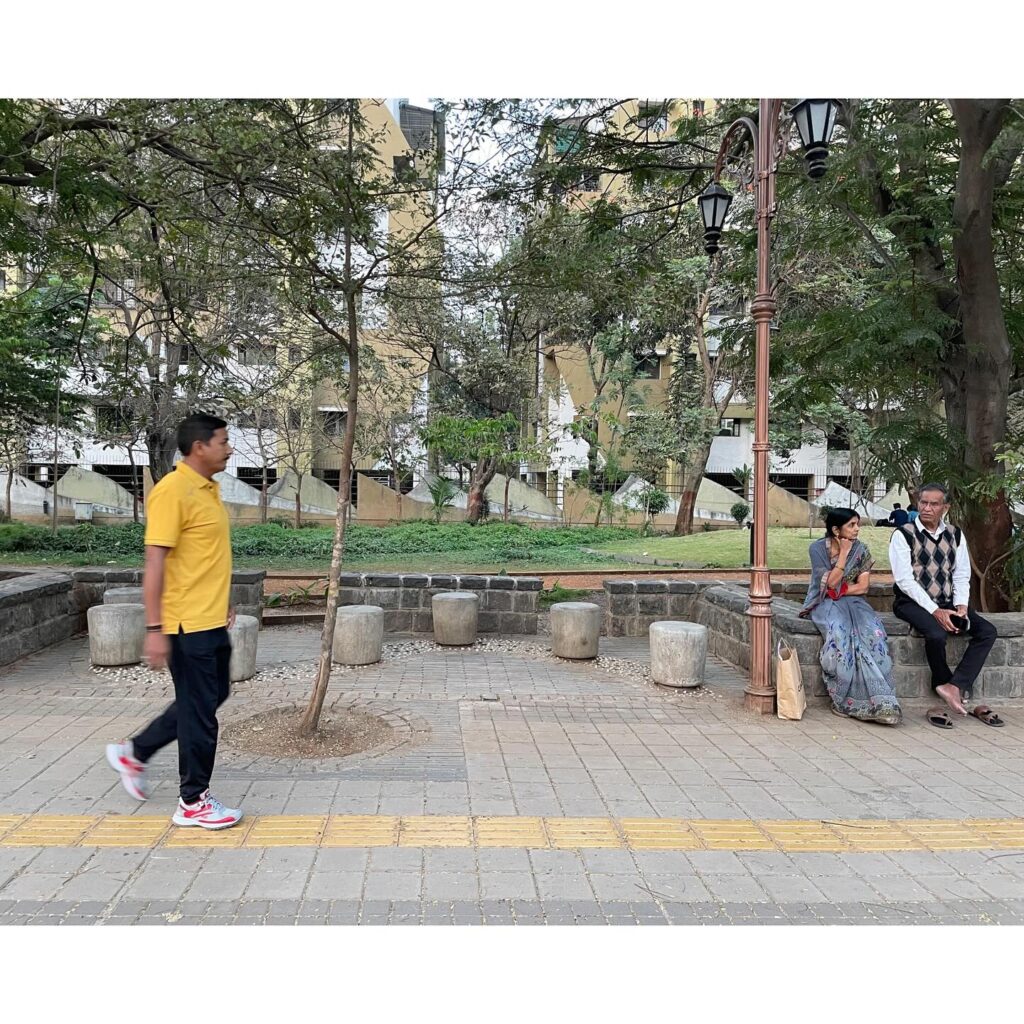
What separates Pimpri Chinchwad’s NMT programme from routine road-building is its explicit framing of streets as public spaces — places where people live, linger, and interact, not just travel through. The “Pimpri Chinchwad on Foot and Cycle” report, produced by PCMC in collaboration with ITDP India, drew on six months of surveys across 13 streets to document how transformed infrastructure changes actual behaviour.
The findings confirmed what street planners have long argued: when footpaths are safe and shaded, people walk. When cycle tracks are protected and continuous, people cycle. The city now has over 100 km of designed streetscapes, making it one of a small group of Indian cities alongside Chennai, Ahmedabad, and parts of Bengaluru, with meaningful NMT infrastructure at scale.
The Linear Garden Street in Pimpri Chinchwad has become something of a reference project within India’s urban planning community — a demonstration that industrial cities are not condemned to car-centric futures. Its success and the replicability of its design principles have informed the broader Harit Setu rollout.
The 15-Minute City Vision
PCMC’s ultimate aspiration is to become a 15-minute city — a concept, popularised internationally by Paris Mayor Anne Hidalgo’s urban planning team, in which daily needs (work, school, groceries, healthcare, recreation) are accessible within a 15-minute walk or cycle from any home. It is an ambitious goal for any city, let alone an Indian industrial hub of 24 lakh people. But PCMC has committed to it explicitly, and has structured both the Harit Setu and the Urban Streetscapes Programme around the neighbourhood-by-neighbourhood transformation that a 15-minute city requires.
The newly formed Urban Mobility Department within PCMC — a structural consolidation that brings transport planning functions under a single institutional roof is expected to increase UTF allocations for sustainable transport in 2025-26, signalling that the administrative machinery is beginning to match the policy ambition.
A Model, But Not Yet a Mirror
India has many cities that have adopted NMT policies. Far fewer have funded them. Fewer still have built institutions capable of sustaining implementation across electoral cycles. PCMC is, by any honest assessment, further along this path than almost any other Indian city of comparable size and industrial character. It’s Green Bond innovation, its budget transparency, its street-level data collection, and its willingness to acknowledge gaps, including the car-centric skew in its own spending, mark it as a genuinely learning institution.
But Pimpri Chinchwad is not yet a mirror in which other cities can see themselves reflected and replicate the outcome. The city benefits from a relatively high per-capita municipal budget, a technically engaged civic administration, and strong civil society partnerships — particularly with ITDP India, which has provided sustained technical support for over a decade. Not every Indian city has these advantages.
What every city can learn from Pimpri Chinchwad, however, is the logic of sequencing: policy before infrastructure, institutions before budgets, pilots before scale. The city did not wait until it had ₹400 crore to spend on NMT before committing to the idea. It built the idea first in policy documents, in budget lines, in pilot streets, and the funding followed.
“Projects such as Harit Setu and Telco Road are not just about infrastructure — they are about creating safer, healthier, and greener lifestyles for citizens.”— Shravan Hardikar, Commissioner, PCMC, quoted in My Pune Plus.
In a country where urban mobility policy is still largely written by engineers for cars, Pimpri Chinchwad has chosen a different authorship, one written by and for the 40-year-old factory worker who cycles to his shift, the teenage girl who walks to college, and the elderly resident who simply wants to reach the vegetable market without risking her life.
Whether the city can sustain and scale that choice, against the pull of flyover budgets, the pressure of vehicle lobbies, and the grinding complexity of Indian urban governance, will determine whether Pimpri Chinchwad’s story ends as a case study or a movement.
For now, it is walking in the right direction.