

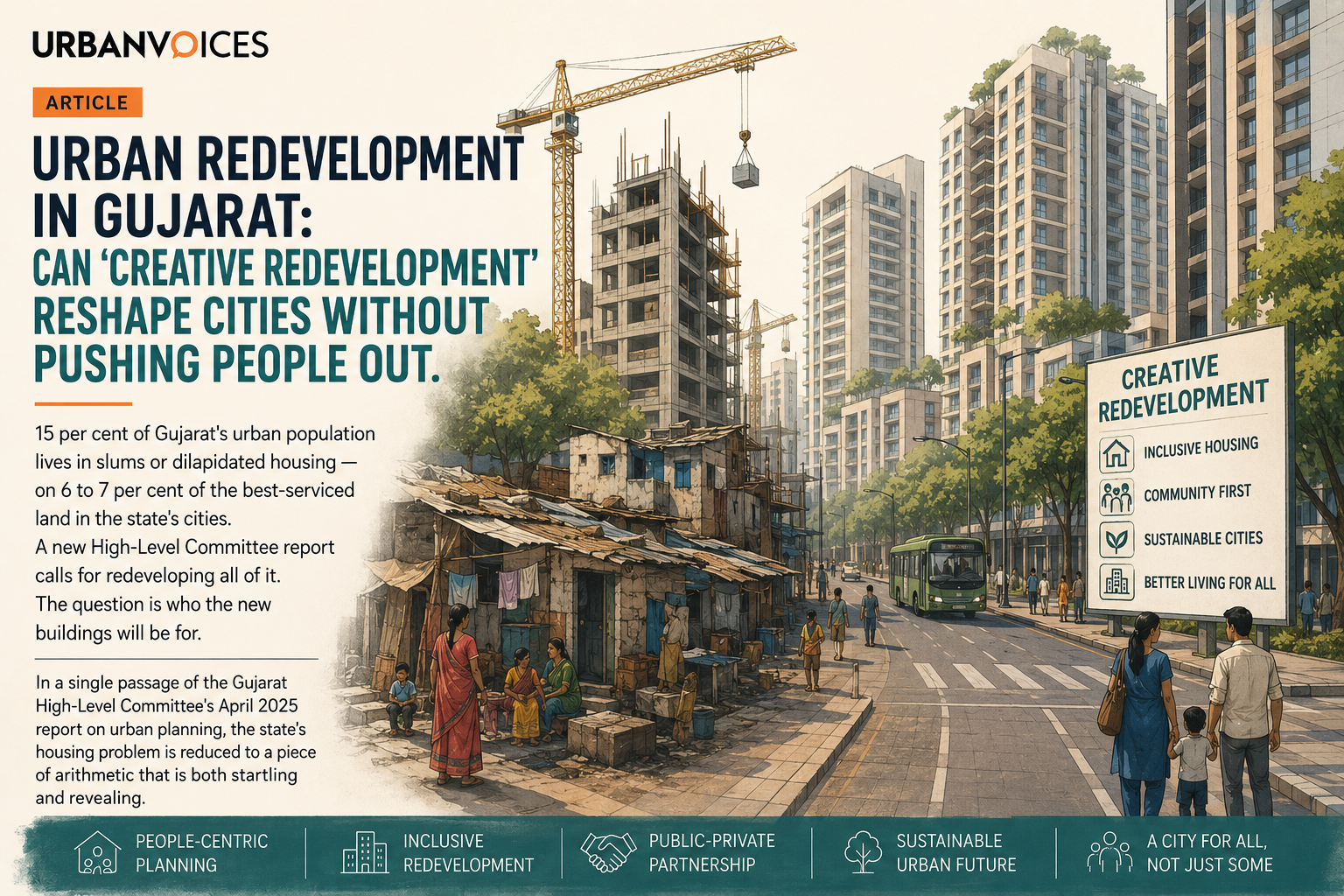
Ahmedabad: 15 per cent of Gujarat’s urban population lives in slums or dilapidated housing on 6 to 7 per cent of the best-serviced land in the state’s cities. A new High-Level Committee report calls for redeveloping all of it. The question is who the new buildings will be for. In a single passage of the Gujarat High-Level Committee’s April 2025 report on urban planning, the state’s housing problem is reduced to a piece of arithmetic that is both startling and revealing.
Twelve per cent of Gujarat’s urban population lives in slums. Another three percent lives in dilapidated public and private housing. Together, fifteen per cent of the urban population occupies roughly six to seven per cent of the most well-serviced urban land at an average Floor Space Index of 0.9.
If you have ever wondered why Indian cities feel simultaneously cramped and underbuilt, this is the math. The most central, best-connected land in cities like Ahmedabad, Surat, and Rajkot is, in built-form terms, hardly built up at all. It is, in the language of the report, grossly underutilised. It is also where Gujarat’s lowest-income urban residents have built their lives.
The chapter that contains this math is titled Creative Redevelopment in Cities of Gujarat. The chapter that follows it is titled Inclusive Cities in Gujarat, authored by Dr Sejal Patel of CEPT University with mentorship from Chairman Keshav Varma.
Read together, they pose what may be the most important urban policy question Gujarat faces this decade: can the state unlock the value of its core city land without displacing the people who currently live on it?
The report’s answer is a cautious yes. The history is more complicated.
What Gujarat redevelopment has already delivered (2010–2023)
The report is not theoretical about redevelopment. Between 2010 and 2023, it documents that approximately 65,122 housing units were redeveloped in Gujarat — about ₹9,123 crore in private sector investment — channelled through three principal policies.
The three pillars of redevelopment
| Policy | Houses redeveloped | Investment | Coverage |
|---|---|---|---|
| Gujarat Slum Rehabilitation Policy (2013, amended 2018/2019) | 35,399 | ₹3,540 cr | Ahmedabad, Rajkot, Vadodara, Vidyanagar, Surat |
| Redevelopment of Public Housing Scheme (2016, amended 2019) | 15,005 | ₹1,500.5 cr | Ahmedabad, Surat, Rajkot, Vadodara, Bhavnagar, Nadiad, Valsad, Modasa |
| In-situ Redevelopment of Private Housing (Flat Ownership Act amendment 2018) | 14,718 | ₹4,083 cr | Ahmedabad, Surat, Rajkot, Bhavnagar, Jamnagar, Nadiad |
| Total | 65,122 | ₹9,123 cr |
In RERA-registered projects alone, the report notes, 4.26 lakh houses were registered in 2021–22, with ₹91,048 crore invested across Gujarat’s real estate market.
Ahmedabad has been the engine.
The city alone accounts for 43 slum redevelopment projects (covering 8.2 hectares), 12 public housing projects (4.8 hectares), 178 private housing redevelopment projects (28 hectares), and 2,162 heritage properties retrofitted. Railway station and bus terminal redevelopment — including Kalupur, Sabarmati, Geeta Mandir, and Ranip — adds another 11.9 hectares.

The momentum is real. So is the geographic concentration. Redevelopment activity, the report concedes, has been confined to roughly 10 cities, accounting for about 15 per cent of the total housing stock and 10 percent of overall real estate investment — strong but spatially limited progress.
How TDR makes the urban redevelopment in Gujarat work
The instrument doing most of the lifting here is Transferable Development Rights (TDR).
The idea is elegant: instead of the government compensating a slum dweller for vacating land, a private developer rebuilds housing for them in-situ and is granted development rights they can use elsewhere in the city, typically to build more floor space on a commercial plot. The developer recovers cost from the secondary site; the resident gets a flat where their kuccha home used to be; the city densifies its core.
In its slum redevelopment chapter, the HLC carries detailed comparison tables showing how the TDR mechanism is staged across Gujarat’s three relevant policies — when stamp duty kicks in, at what stage Building Use certificates are granted, and how much TDR is released against what construction milestone.
Eighty per cent of Heritage TDR, for instance, is released only after Building Use permission under one scheme.
These are technical details, but they matter. The financial logic of every redevelopment project sits inside these milestones. So does the resident’s risk: if the developer’s project stalls between the demolition of the existing housing and the issuance of the new BU, the people whose flats were the original asset are the ones most exposed.
To address this, the committee proposes inserting structured TDR sections directly into Gujarat’s Comprehensive General Development Control Regulations (CGDCR) 2017, proposed sections 8.6 and 8.7, to give each redevelopment pathway a clear regulatory home and predictable rules.
The 5,375 hectares of redevelopment potential in Ahmedabad alone
Where the report becomes ambitious, some would say audacious, is in its assessment of potential.
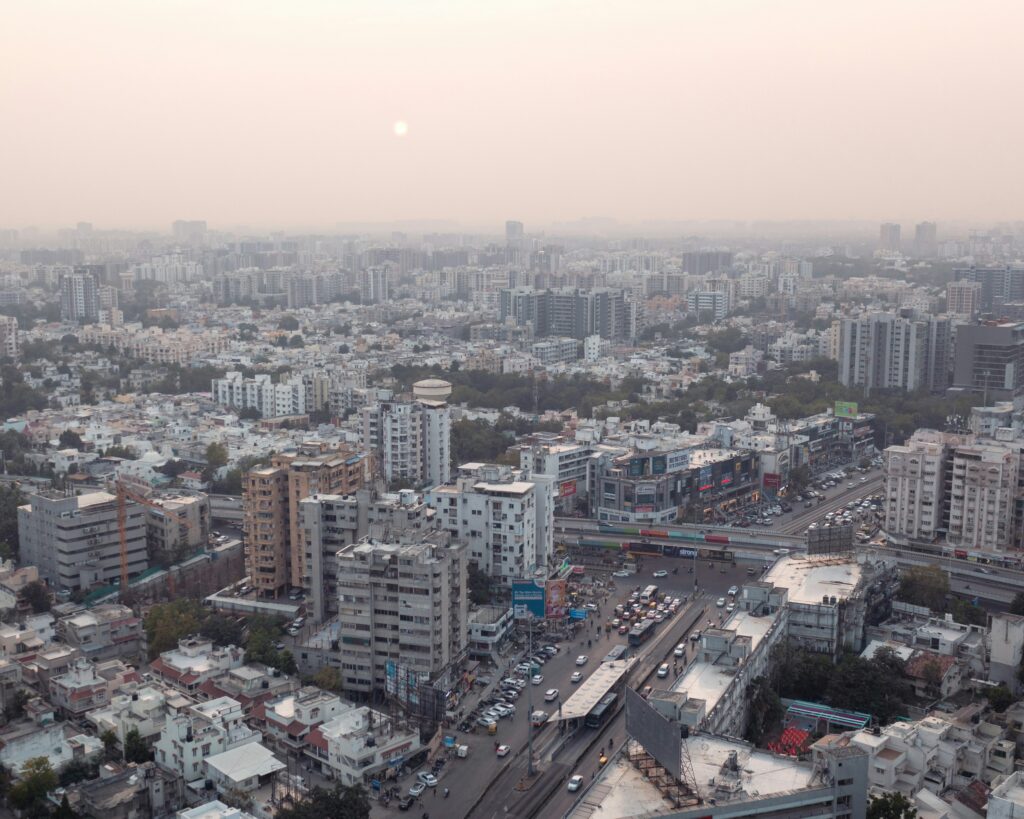
Ahmedabad alone, the HLC identifies, has approximately 5,375 hectares of underutilised land available for redevelopment. The pipeline includes:
- 16 further slum redevelopment projects on public land
- 44 public housing projects identified by the Ahmedabad Municipal Corporation (AMC)
- 25 projects by the Ahmedabad Urban Development Authority (AUDA)
- 216 projects by the Gujarat Housing Board (GHB)
- 43.75 sq km earmarked for private housing redevelopment
- 3.5 sq km around Vatva, Maninagar, and Asarwa railway stations
This is, in scale, one of the largest urban redevelopment pipelines anywhere in India.
The committee’s framing is unapologetically economic. The report is clear that as Gujarat aims to grow GSDP from USD 281 billion to USD 1 trillion by 2035, the underuse of central urban land is a constraint. Redeveloping it, the committee argues, would simultaneously uplift living standards, lower infrastructure cost per capita, increase property tax revenue, and reduce sprawl.
The Inclusive Cities chapter that quietly pushes back
Then comes the next chapter — Inclusive Cities in Gujarat. And it does something the redevelopment chapter mostly does not. It asks, persistently, who urban transformation is for.
The chapter opens with a sobering set of numbers. Despite being India’s fifth-largest contributor to GDP, Gujarat falls under the medium Human Development Index bracket with a score of 0.638, ranking 23rd among Indian states and Union Territories. 11.66 per cent of Gujarat’s population is multidimensionally poor. Urban slums house roughly 1.68 million people about 2.8 per cent of the state’s population. About 1.81 per cent of Gujaratis live with a physical disability, and roughly 9 per cent of the population is elderly (2011 Census; projected to reach 12 percent by 2031). The report notes plainly that a considerable number of buildings in Ahmedabad lack accessibility for disabled individuals.
The ‘housing ladder’ that Gujarat has assembled
The chapter’s central image is a housing ladder — a visual catalogue of the policies Gujarat has built up:
- Bottom rungs: BOCW Act housing for construction workers, NULM urban homeless shelters
- Middle rungs: Slum upgrade and Resettlement & Rehabilitation, PMAY-U’s Affordable Rental Housing Complexes (ARHCs)
- Upper rungs: Gujarat Housing Board public stock, inclusionary RAH (Residential Affordable Housing) zones
- Top rung: Private market housing
The ladder exists. The question is whether someone can move up it.
The chapter argues, in effect, that inclusion is not a soft outcome to be bolted onto urban policy — it is a precondition for the kind of economic transformation Gujarat is reaching for. Inclusive planning, it suggests, raises the productivity of human capital, accelerates economic development, and helps Gujarat reach its USD 1 trillion ambition. It is a pragmatic frame for an ethical argument.
The chapter then makes specific demands of the redevelopment system:
- Housing for women, the elderly, and the differently-abled should be treated as design constraints, not afterthoughts.
- Workspace and livelihood inclusion — particularly for urban poor women and street vendors — should be planned for explicitly.
- Mobility and public space design should be assessed against the experience of those who depend on them most.
The unresolved tension between the two chapters
What the two chapters do not quite reconcile is the tension between them.
Creative redevelopment, as the HLC describes it, depends on a financial calculus where the value unlocked from densifying core urban land justifies — and pays for — the new housing on the site. When the math works, the existing resident is rehoused in-situ in a new flat, and the developer is compensated by additional development rights. When the math is tight, something has to give.
Often, it is the size or quality of the rehab unit. Sometimes it is the resident’s willingness to wait through three or four years of construction in temporary accommodation. Occasionally, it is the original number of households accommodated on the site, especially where informal residents lack documented tenure.
The Inclusive Cities chapter is alive to this. The redevelopment chapter — focused, by design, on momentum and scale — moves past it more quickly.
For Gujarat to make the 5,375 hectares of Ahmedabad’s redevelopment pipeline actually work for the 15 per cent of urban Gujarat that the HLC’s own math identifies as underhoused, both chapters will need to be read together.
The recommendations need to interlock: TDR rules that protect resident timelines as well as developer returns; design standards that bring accessibility, women’s safety, and ageing-in-place into the basic vocabulary of redevelopment; and statutory backing — through proposed CGDCR sections 8.6 and 8.7 — that makes inclusion a feature of every project, not a negotiable add-on.
Three signals to watch over the next two years
For readers tracking how this plays out on the ground, three things will tell us which way Gujarat is leaning.
First, whether the proposed CGDCR insertions are actually notified — and whether the inclusion clauses are written in or written out.
Second, whether the 216 GHB redevelopment projects in Ahmedabad’s pipeline include explicit social-housing reservations, accessibility standards, and rental options for the lowest-income tier of the housing ladder.
Third, whether the next set of redevelopment pilots happens in cities beyond the current ten — in Bhavnagar, Junagadh, Anand, Bhuj, Patan — places where the political economy of land is different, and where a more equitable model could be tested before being scaled.
The HLC’s report is, ultimately, the state government talking to itself in print. The redevelopment chapter shows what is possible. The Inclusive Cities chapter shows what is necessary. The next chapter — the one that gets written into rules and built into buildings — is the one that will matter.
This concludes the three-part Urban Voices series on the Gujarat HLC report (April 2025).
- Part 1: Gujarat Urban Planning 2047 — Does the State Have the Planners?
- Part 2: Urban Flooding in Gujarat — The Disappearing Lakes Behind the Crisis
Source: Report of the High-Level Committee on Urban Planning, Urban Development & Urban Housing Department, Government of Gujarat, April 2025. Chapter on Creative Redevelopment authored under the High-Level Committee. Chapter on Inclusive Cities authored by Dr Sejal Patel, Professor, CEPT University, mentored by Chairman Keshav Varma.



[…] Part 3: Urban Redevelopment in Gujarat — Can ‘Creative Redevelopment’ Reshape Cities Without P… […]