
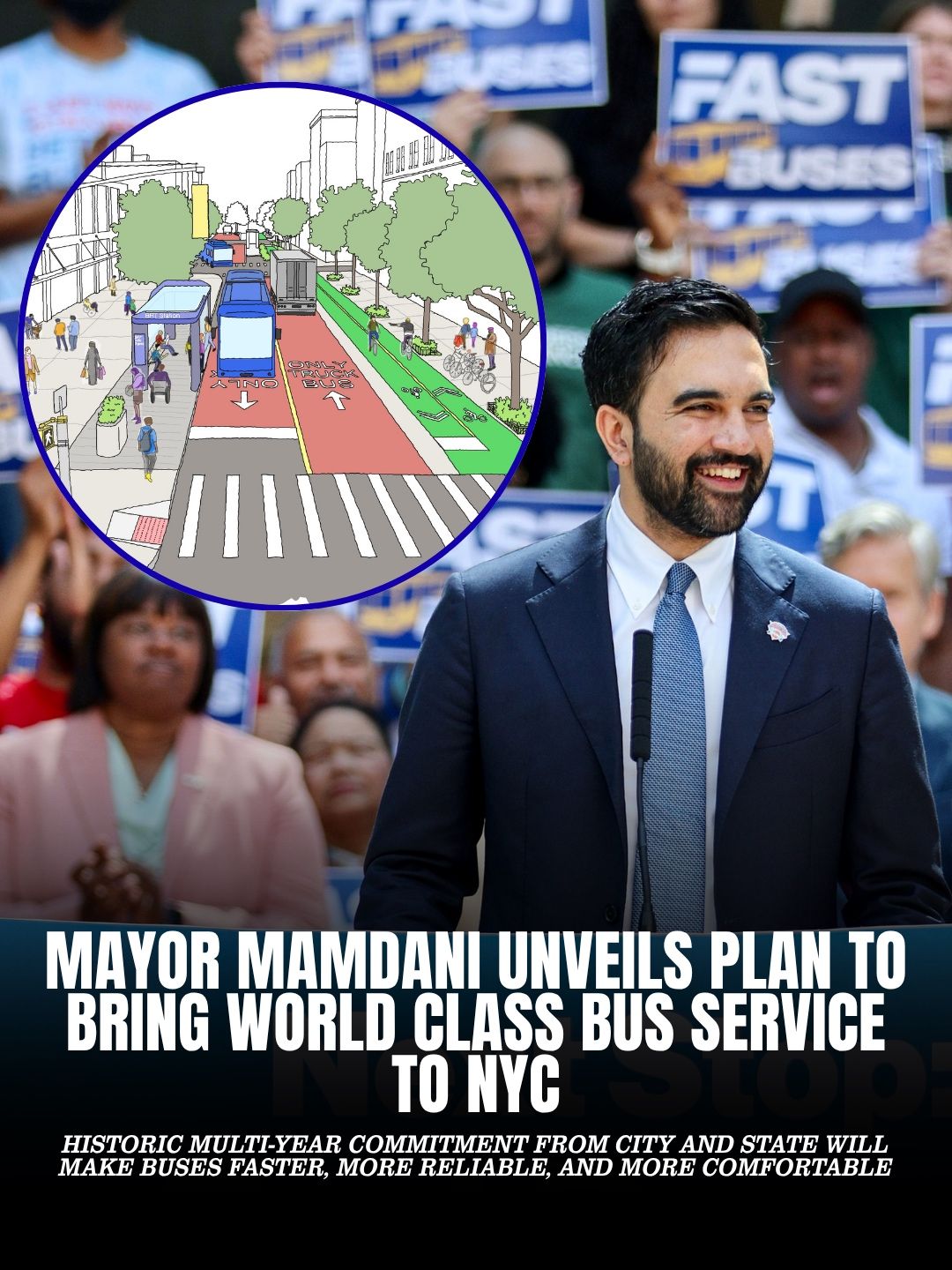
New York: New York City has launched an ambitious plan to speed up its notoriously slow buses, promising commuters up to six minutes back on every trip.
On 8 July, Mayor Zohran Mamdani and Gov. Kathy Hochul unveiled Next Stop: Fast Buses, Better Service, a sweeping action plan by the New York City Department of Transportation (NYC DOT) and the Metropolitan Transportation Authority (MTA) to overhaul the city’s bus network.
At its core, the plan targets a 20% increase in bus speeds on 50 priority corridors, reducing trips by as much as six minutes on each trip — routes in a city where buses average just eight miles per hour, the slowest of any major U.S. city. New Yorkers take 2.75 million bus trips a day, making the system the busiest in the nation.
Five stretches, Tremont/Cross Bronx, Northern Boulevard, Flatbush Avenue, Utica Avenue and Kensington-JFK — will become the city’s first “rapid bus corridors,” with dedicated lanes, upgraded stations and sheltered waiting areas.
The plan also promises all-door boarding in 2027 and approximately 2,500 new buses through the MTA’s historic $68 billion 2025-2029 Capital Program, which will replace 40% of its ageing fleet. To keep lanes clear, NYC DOT will install 200 additional stationary bus lane cameras by 2027.
- More dedicated bus space like bus lanes and busways
- All door boarding on buses by 2027
- Increased enforcement for bus lane offences
- New technology to keep buses moving quickly through traffic
- Real-time arrival time information at bus stops
- Universal seating at bus stops by 2035.
“In New York City, time is money, and we are going to give New Yorkers some of that time back, six minutes to be precise,” Mamdani said at a Downtown Brooklyn press conference.
The roughly $850-million effort delivers the “fast” half of Mamdani’s “fast and free” campaign pledge; the plan does not address the other part of the promise, to make buses free, which would need state approval.
Officials say improvements will begin this year, with performance data released within six to 12 months after projects are completed. For a system long criticised as unreliable, the message from City Hall was blunt: the wait is about to get shorter.