

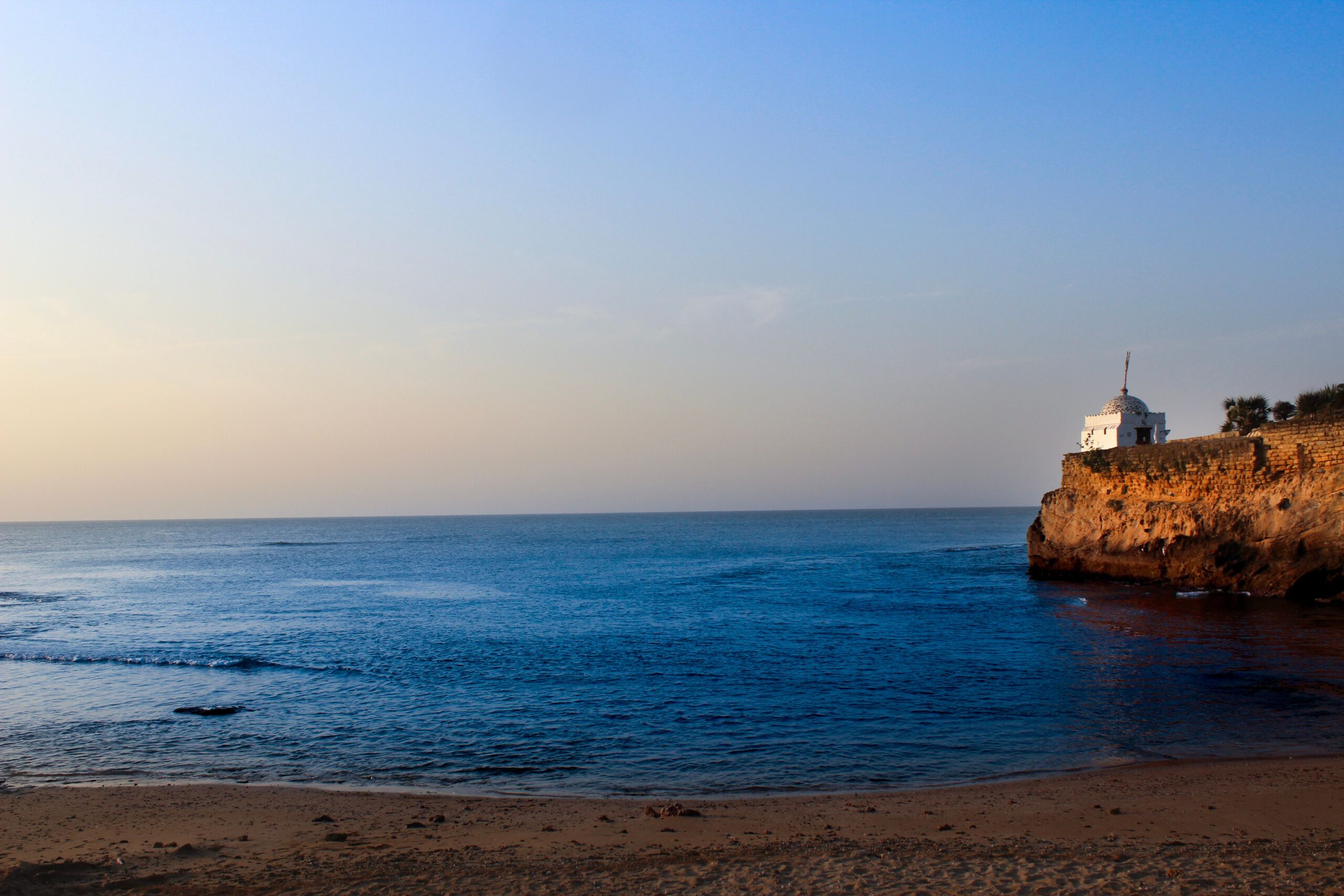
Diu, walk along Diu’s new coastal promenade on a hot afternoon, and you notice the paving before you notice the shade. The lighting is smart. The access is better. The promenade is genuinely lovely. But the trees, the living, breathing, canopy kind are mostly missing. Which raises an uncomfortable question for every Indian city rebuilding itself right now in name of smart cities : are we designing progress, or just paving it?
The question hiding under the concrete
How does anything grow, flourish or expand when it’s surrounded by something as unyielding as concrete?
It sounds like a simple question. It isn’t. It sits under almost every decision we make about our cities.
Look around. A child growing up in a dense neighbourhood. A scrap of land wedged between two roads and a parking lot. A sapling fighting its way out of a one-square-metre gap in a sea of pavement. Different scales. Same story.
Growth needs space. Not just physical space — ecological space, mental space, social space.
Yet our answer to every urban problem seems to be the same. More concrete. More roads. More plazas. More promenades. More surfaces that resist nature instead of working with it.
The irony writes itself. We build cities to improve human life, only to create environments that cut us off from the very systems that keep us alive.
What we build is never neutral
Architecture and urban design are never neutral choices. Every material, every street layout, every public space nudges behaviour.
Designers love to talk about how spaces affect people — movement, comfort, safety, beauty. The emerging field of neuroarchitecture shows our surroundings shape our stress, our moods, even our health.
But the built environment reaches far beyond human psychology. What we build affects soil. It affects biodiversity. It affects the water cycle. It affects temperature.
Every square metre sealed under impermeable concrete is a square metre taken away from the earth’s ability to breathe, soak up rain and support life.
In India this isn’t abstract. Rapid, unplanned growth has already made our cities warm up around 60% faster than the surrounding countryside. City design keeps choosing construction and road-widening over shade, canopy and water.
We already know what’s right
Here’s the uncomfortable part. Deep down, most of us already know the answer.
We know children need trees. We know neighbourhoods need shaded places to gather. We know birds, insects and small ecosystems need habitat. We know green cities are cooler, healthier and more resilient.
So why do we keep choosing hard surfaces over living systems?
Maybe it isn’t a lack of knowledge. Maybe it’s a lack of imagination. Or maybe something more unsettling: have our thoughts become as concrete as the environments we build?
Spend every day surrounded by grey, sealed ground, and you slowly accept it as normal. The exception becomes the standard. The warning becomes “progress.” And nature becomes decoration.
Concrete isn’t the enemy
To be clear, this isn’t an argument against concrete. Concrete built our homes, hospitals, schools and high-rises. Our cities could not function without it.
The problem isn’t concrete. It’s concrete’s dominance.
We’ve become brilliant at building upward. In the process, we’ve forgotten how to build downward into the ground, into ecosystems, into a relationship with nature. If concrete lets us rise into the sky, the ground beneath our feet should reconnect us to the earth.
The space between buildings matters as much as the buildings. The ground plane shouldn’t be an afterthought. It should be where nature begins.
The ground is where life happens
The best moments in a city rarely happen inside towers. They happen under trees. On shaded footpaths. In parks and courtyards. On streets where people can actually see each other.
A tree is not a decoration. It is shade. It is habitat. It is climate control. It is carbon storage. It is a social catalyst. It is, quite literally, infrastructure. Yet we treat it as optional.
The numbers show how optional. The WHO suggests at least 9 sq m of green space per city resident, while India’s own URDPFI guidelines recommend 10–12 sq m per person — and most Indian metros fall far short. We don’t have a knowledge problem. We have a priorities problem. Planting drives are one attempt to close the gap — but planting is only half the job if the ground stays sealed.
A slower walk through Diu
Which brings us back to Diu.
The redevelopment there- new promenades, better access, upgraded amenities under the Smart Cities Mission is celebrated as progress. And in many ways, it is.
But take a slower walk. Pause. Look past the people to the environment around them. Notice the wide stretches of hardscape. Notice how little canopy there is at the hottest hour. Notice the missing mature shade — not shade from a structure, but shade from a living thing.
A built canopy protects people. A tree canopy protects a whole system. It cools the air, feeds pollinators, holds soil, stores carbon, creates microclimates and offers a sensory richness no manufactured material can fake.
We celebrate what we can see the paving, the lighting, the railings. What stays invisible are the ecological services trees quietly deliver every single day. And what stays invisible is usually what we value least.
Designing for more than humans
Maybe this is where design has to grow up.
A public space shouldn’t be judged only by how many people use it. It should also be judged by how much life it supports. How many birds come back. How many pollinators thrive. How much groundwater is recharged. How much heat is shed. How many children grow up knowing cities and nature aren’t opposites.
Because we aren’t only designing for today’s users. We’re setting the conditions for the next generation.
The question was never whether we can keep building with concrete. Of course we can. The real question is whether we can build cities where concrete and nature share the ground. Cities where growth doesn’t cost us life. Cities where the ground stays alive.
Because if a plant struggles to grow when it’s surrounded by concrete, we might have to ask the harder question.
What happens to people when they’re surrounded by it too?



[…] Link to full article: https://urbanvoices.in/are-we-designing-progress-or-just-paving-it-in-the-name-of-smart-cities/ […]