

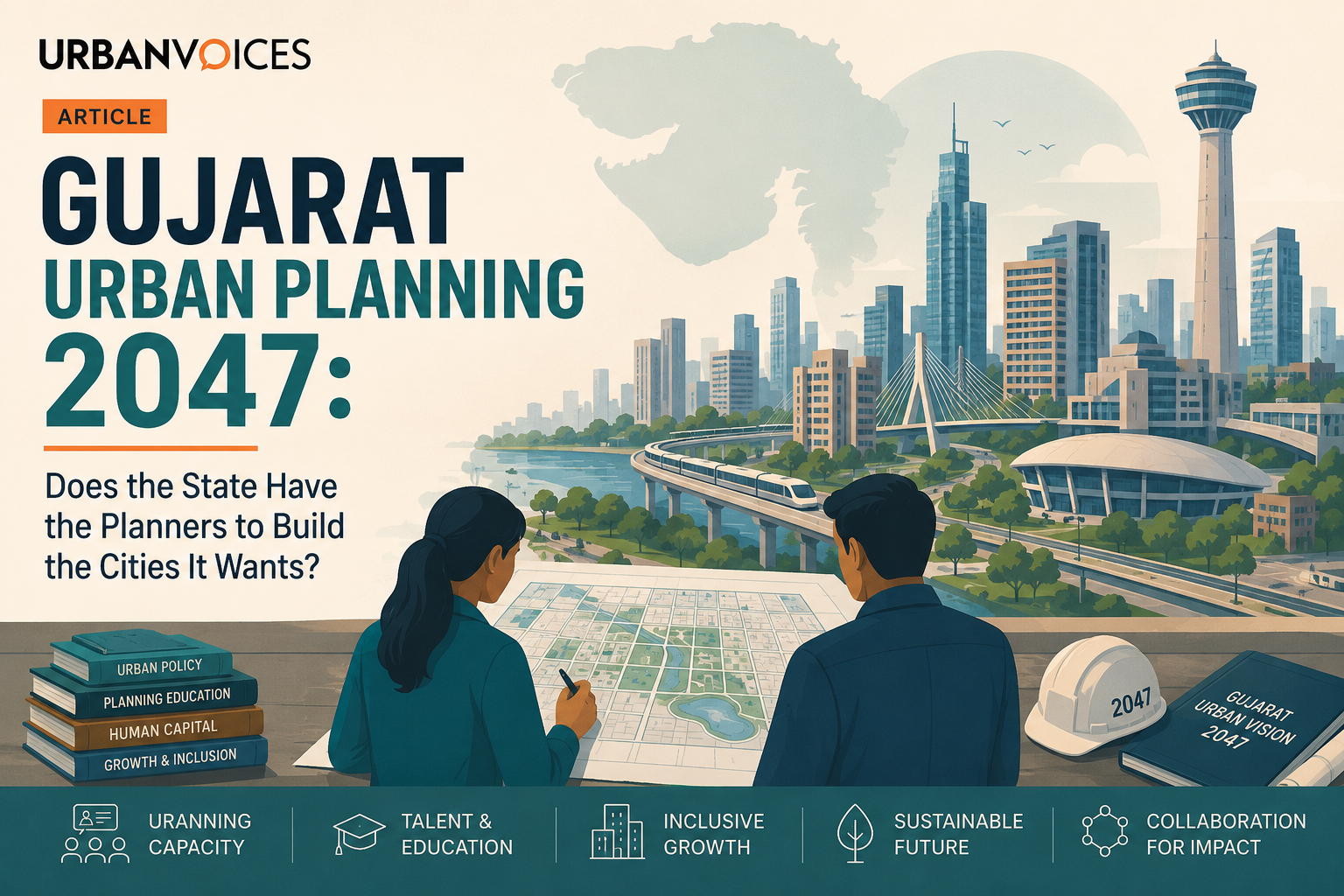
Gujarat has declared 2025 the Year of Urban Development and aims for 70% urbanisation by 2047. But the state’s own High-Level Committee report admits the planning system that has to deliver this transformation is short of people, short of jurisdiction, and short of time. Gujarat urban planning can make or break the Gujarat model of development.
In April 2025, a quietly authored 268-page document landed on the desk of Gujarat’s Urban Development and Urban Housing Department titled simply Report of the High-Level Committee on Urban Planning, it is the first volume in a series the Government of Gujarat has commissioned to imagine what its cities should look like by 2047, the year the state hopes to be a developed economy with a GSDP of USD 3.5 trillion.
The report celebrates a great deal. Gujarat has more than 1,600 km of coastline, 19 operational airports, over 5,200 km of rail, more than 200 industrial parks, and the upcoming Dholera airport. Night-light satellite data shows the state’s built-up glow grew by roughly 58 per cent between 2012 and 2021. The Mumbai-Ahmedabad high-speed rail will, the foreword promises, transform the urban landscape of the state.
But buried in the chapter on Professionalisation and Institutional Strengthening is a number that should give every Gujarati city-watcher pause.
Gujarat will need between 1,300 and 2,100 urban planners by 2047 to plan and govern its cities at the scale it has in mind. The state today does not have anywhere close to that. And the gap is not academic — it is already visible on the ground, every year, in roughly 100 square kilometres of farmland that quietly turns into something else.
The 100 sq km of unplanned development that no one is watching
A stack of laws governs spatial development in Gujarat: the Gujarat Panchayats Act, the Gujarat Municipalities Act, the Municipal Corporation Act, and the Gujarat Town Planning and Urban Development Act (GTPUDA), 1976. Inside the areas covered by an Urban Development Authority (UDA) or Area Development Authority (ADA), there are Development Plans, Town Planning Schemes, layout norms, and a District Town Planner whose opinion is sought.
Outside those areas, the story changes. Permissions there happen largely through Non-Agricultural (NA) layouts issued by gram panchayats on the advice of a district town planner. The committee’s analysis finds that over the last five years, roughly 477 sq km of rural area received layout opinions through this route, averaging about 100 sq km per year of new development outside any declared planning authority.
For context: of Gujarat’s 1,96,024 sq km of geographical area, only about 12,707 sq km, roughly 6.4 per cent of the state, is currently covered by a UDA or ADA. The rest is, in planning terms, a frontier. And it is exactly the frontier where rapid economic growth is now arriving along infrastructure corridors, rail lines, and the edges of expanding cities.
Of Gujarat’s 166 statutory Urban Local Bodies (ULBs), the report flags, 47 sit outside any declared UDA or ADA — meaning the municipal area exists, but no statutory development authority is preparing the kind of long-horizon plan that big cities take for granted.
This is the quiet structural story underneath every news item about an unplanned colony, a clogged stormwater drain, or a building that came up where a lake used to be: a planning architecture designed for an earlier Gujarat is being asked to escort a much larger one.
Why this matters for everyday Gujaratis
When permissions are issued without a statutory plan, neighbourhood-scale decisions — road widths, drainage, open spaces, school sites — are made one plot at a time, with no coordination. The result is the kind of urban texture residents now recognise across peri-urban Ahmedabad, Surat, Vadodara, and Rajkot: arterials that dead-end into a private boundary wall, drains that empty into nothing, plots that flood every monsoon because the next plot was raised six inches higher.
The ‘urbanised village’ that the census doesn’t yet see
If you have driven the highway between Ahmedabad and Mehsana, or between Surat and Navsari, you have probably noticed it without naming it — settlements that look urban, function urban, and yet are administratively villages.
The committee names this. Drawing on Census 2011 trends and a 2023 district-level analysis by Roy and Saha, it documents the rise of census towns in peripheral regions away from traditional urban centres. These are high-density rural settlements where the workforce has moved from agriculture to non-farm work, but where governance, infrastructure norms, and planning instruments still operate on village rules.
The HLC projects that approximately 308 villages will transition into urban areas every five years. The number of Class A municipalities will rise from 30 in 2011 to 43 by 2047. Metropolitan cities, from 17 to 21. By 2036, Gujarat is expected to be the fourth most urbanised state in India, with 55 per cent of its population in cities; by 2047, the state’s own Viksit Gujarat roadmap targets 70 per cent urbanisation.
This is not a forecast in search of a policy. It is a policy in search of a workforce.
Five fixes the committee is asking the state to make in the Gujarat Urban Planning
The report does not stop at diagnosis. Its second half lays out a Theory of Change for what it calls Viksit Urban Gujarat, built around five interlocking reforms.
1. Gujarat Wide Institutional Network (G-WIN)
A formal coalition of the state’s planning schools, professional bodies, and research institutions, so that capacity-building stops being a one-off project. The premise is simple: Gujarat cannot hire its way to 2,000 planners without building the pipeline first.
2. A Gujarat Urban Professional Service Cadre
A dedicated cadre of urban planners with career tracks, posting policies, and mid-career training — modelled on how civil services treat their own. The current arrangement, where planning capacity sits unevenly across departments and authorities, is, in the committee’s view, structurally unable to deliver a 2047-scale transformation.
3. Augmenting district-level planning capacity
Bringing serious planning muscle down to the district, where most NA permissions are actually issued and where most peri-urban growth is happening invisibly. The committee’s recommended staffing norm scales by city class — for instance, three to eight professionals for Class A and B municipalities, depending on functions.
4. A Gujarat State Urban Observatory
A continuously updated, GIS-grounded data infrastructure on land, water, mobility, and housing — so plans rest on evidence rather than memory. The HLC repeatedly returns to the point that evidence-based research should anchor recommendations.
5. Strengthening TPVD and planning SPV
Strengthening the Town Planning and Valuation Department as the institutional spine of Viksit Gujarat 2047, alongside a proposed Special Purpose Vehicle for High-Quality Urban Planning that can commission complex, multi-year planning projects without being limited by line-department procurement norms.
There is also a quieter, important suggestion: the sensitisation of civil servants to urban planning. The committee notes that many decisions which shape cities, district administration, revenue, and public works are made by officers whose training does not centre on urban form. A planner-only solution, the report implies, will fail without a planner-aware administration.
Who wrote the report — and why that matters
The HLC is chaired by Keshav Varma, a retired IAS officer, former Sector Director at the World Bank, and currently Chairman of the Sabarmati Riverfront Development Corporation in Ahmedabad. The Vice-Chairman is Ashwini Kumar, Principal Secretary of Gujarat’s Urban Development and Urban Housing Department. The Core Committee includes Chief Town Planner D. J. Jadeja, Surat Municipal Commissioner Shalini Agarwal, AUDA’s D. P. Desai, and CEPT University professors Saswat Bandyopadhyay and Sejal Patel.
This is not, in other words, an outside critique handed to the government. It is the state’s own assembled expertise telling the state, in writing, that the current planning architecture is not adequate to the scale of urbanisation Gujarat has chosen to pursue.
That is a candid admission, and that is what makes the report unusual. Whether it translates into a notified cadre, a funded observatory, and a statutory expansion of where Development Plans must be prepared, those are political choices that will be made over the next five years, mostly out of the headlines.
What to watch over the next 24 months
For readers tracking urban governance in Gujarat, three signals will tell us which way the state is moving:
- A notified Gujarat Urban Professional Service Cadre — without it, the planner shortage is structurally unfixable.
- An operating State Urban Observatory with public data feeds — without it, “evidence-based planning” stays a phrase.
- Statutory expansion of Development Plan jurisdiction to cover at least the urbanising 308-villages-every-five-years pipeline without it, the 100 sq km a year of unplanned development continues.
For now, the numbers sit on the page. 308 villages are becoming towns every five years. 100 sq km of new development annually outside planning jurisdictions. A planner gap of well over a thousand professionals. And a state that has declared 2025 the Year of Urban Development, with the work, mostly, still ahead of it.
Read next in this series:



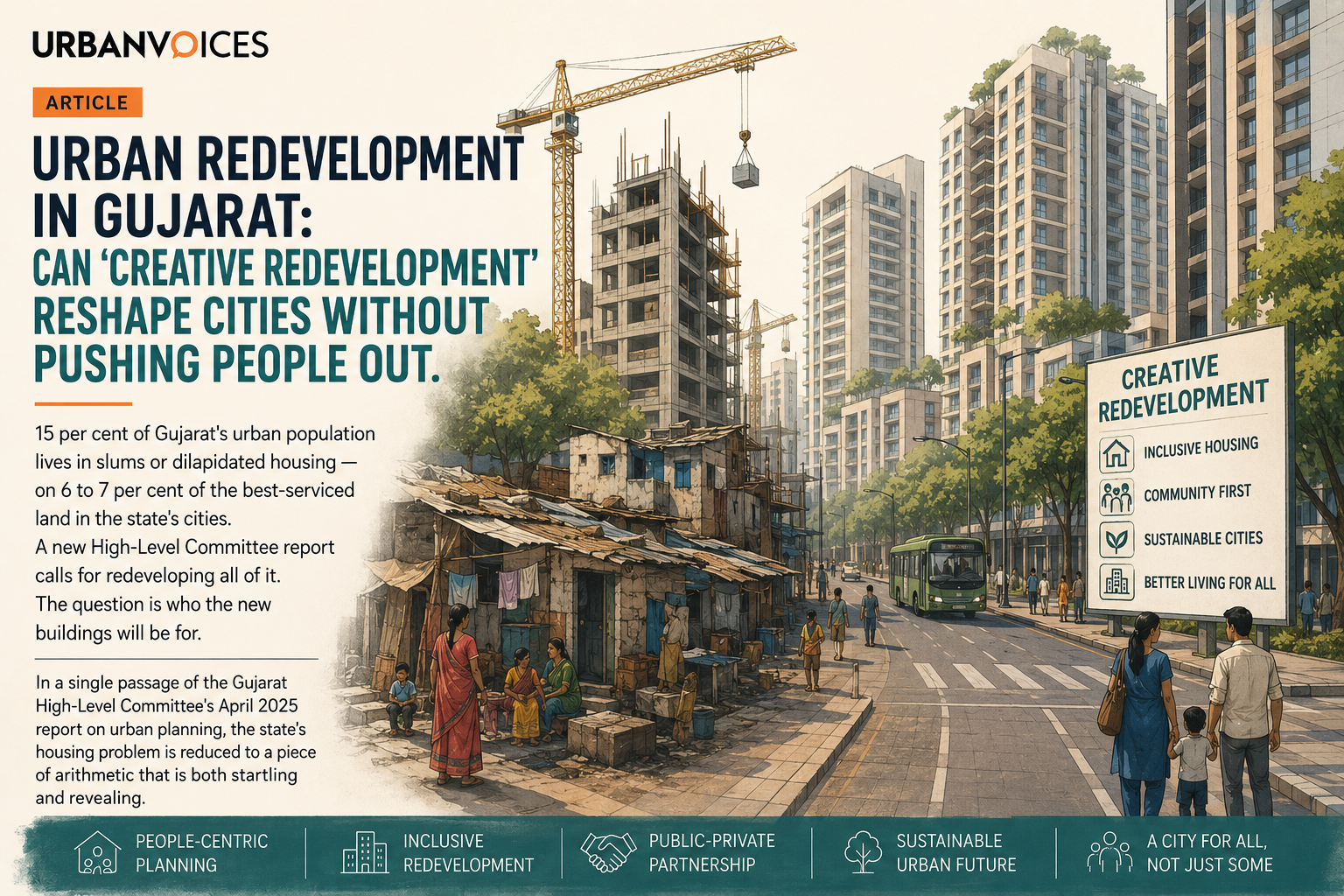
[…] Part 1: Gujarat Urban Planning 2047 — Does the State Have the Planners? […]
This article has taken a simplistic view of Urban crisis in the State. Issues of corruption, non transparent regulations, domination of real estate interest and weak local bodies in urban sector is not going to be resolved by increasing number of planners or adding an urban observatory or a state cadre of planners. I am sure the report goes much beyond the narrow recommendations of adding more planners. Let us not give an impression that there is a technical solution to systematic problems of urban sector.
This piece is the first in a planned series, and we are trying to cover as much of the report as we reasonably can across the articles to follow including water and the quiet erasure of lakes through statutory TP schemes (which is really a transparency-and-capture story), and the redevelopment-and-inclusion question of who gets to stay when prime urban land is unlocked. Even then, a series can only do so much justice to a document this dense (it is 265 page), and your reminder that we shouldn’t let readers walk away thinking systemic problems have technical solutions is one we’ll carry forward into the rest of the pieces.
Grateful for the engagement, comments & feedbacks like this make the series better. Also, in the whole report, the word “corruption” has not appeared at all.
[…] Part 1: Gujarat Urban Planning 2047 — Does the State Have the Planners? […]