
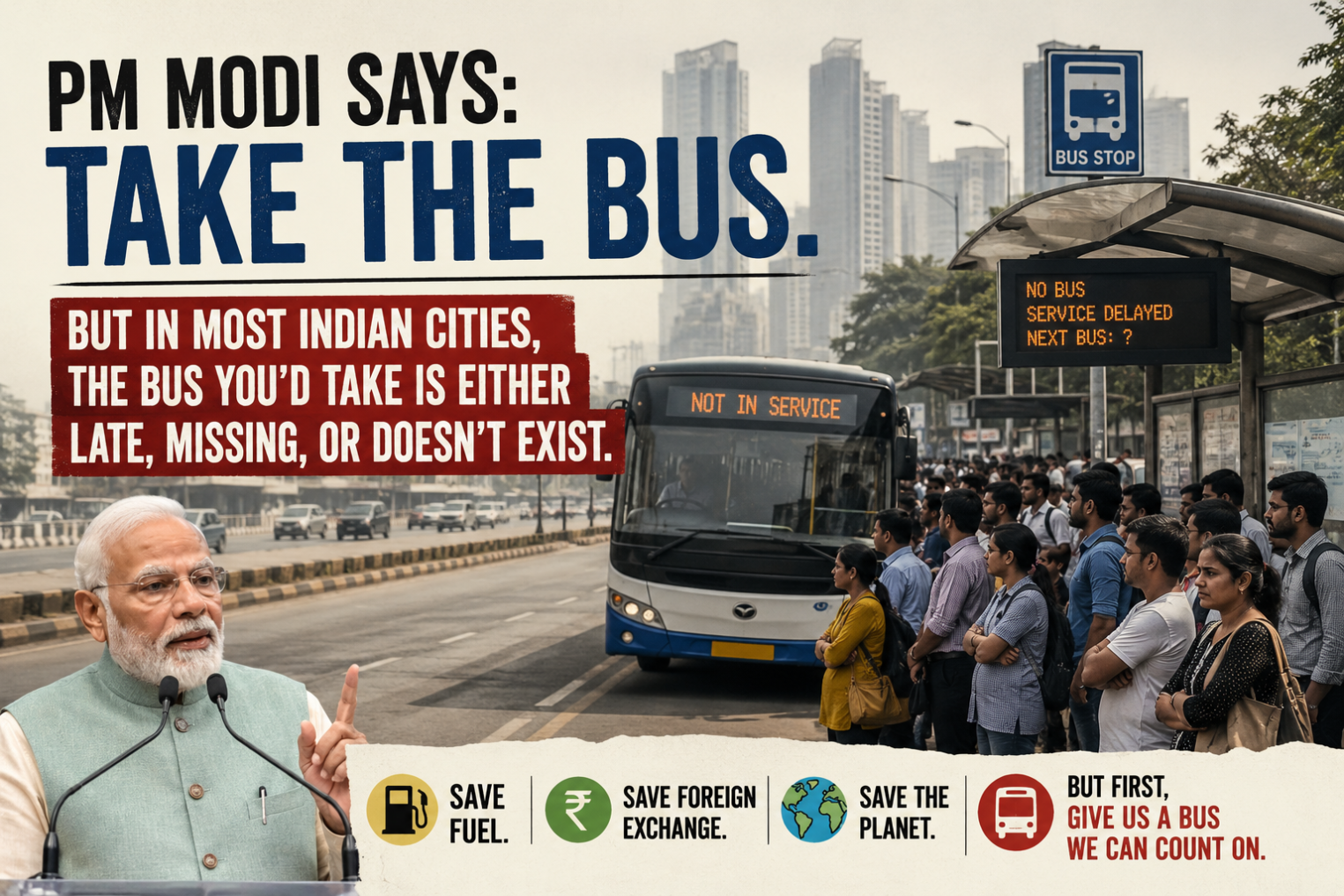
On May 10, 2026, Prime Minister Narendra Modi asked Indians to do something deceptively simple – take the bus. Speaking in Hyderabad against the backdrop of a West Asia oil crisis, he urged people in metro cities to ditch private cars, carpool when they must drive, and embrace electric vehicles. The goal: save fuel, save foreign exchange, save the planet a little. There’s just one catch — in most Indian cities, the bus you’d take is either late, missing, or doesn’t exist.
The PM’s appeal to ride the metro and skip the car is well-meaning. India’s broken bus systems may not be ready to oblige.
The Appeal and the Quick Photo-Op
Modi’s pitch wasn’t subtle. He framed it as “economic self-defence”, invoking memories of the COVID work-from-home era and asking citizens to cut petrol use, defer gold buying, and rethink overseas vacations. India imports nearly 88% of its crude oil, so every commute on a bus is one less rupee leaving the country.
Within hours, the political class jumped in. Union Minister Ramdas Athawale posed for cameras on the Delhi Metro. The Gujarat Governor announced he’d swap helicopters for state transport buses. Uttar Pradesh CM Yogi Adityanath cut VIP convoys by 50% and asked staff to take the Metro. Maharashtra restricted aircraft for ministers.
Symbolism? Plenty. Substance? That’s where it gets uncomfortable.
Meanwhile, in Bhopal…
Bhopal’s shiny new Metro began operations in December 2025. By May 2026, daily ridership was struggling to cross 100 commuters. Yes, you read that right- one hundred. The corridor is too short and disconnected to be useful. Officials say it’ll take two more years before it actually serves the city.
Meanwhile, Madhya Pradesh’s 16 municipal corporations burn through nearly ₹11 crore worth of fuel every single day in private vehicles. Why? Because the state shut down its public bus corporation back in 2005 and never quite replaced it. Twenty years and counting.
“What public transport?” ask 9 crore people in Madhya Pradesh.
The Public Transport Scoreboard: How Major Cities Stack Up
Let’s look at the numbers across India’s big cities. Government policy recommends a public transport mode share of 40-45% in million-plus cities and 75% in cities above 5 million. The reality? An average of just 33% in Tier-1 and Tier-2 cities, and a depressing 4% in Tier-3 towns.
City-by-City: A Quick Reality Check
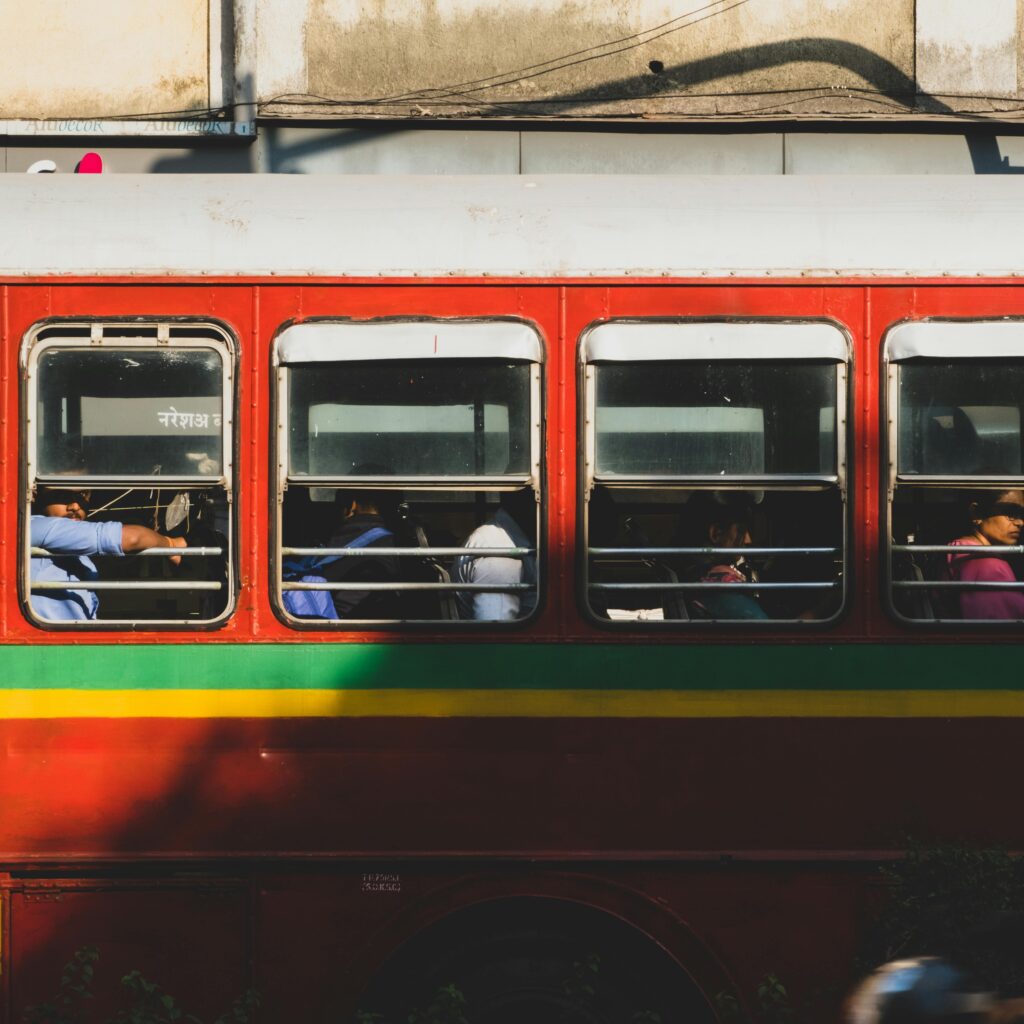
- Mumbai: Once the gold standard for public transport (52% mode share, helped by suburban rail), the city has steadily slipped. The BEST bus routes fell from 468 in July 2021 to 404 by June 2025.
- Delhi: Has the highest registered vehicles in India — 11.89 million. Its DTC bus fleet shrank from 4,344 to 3,762 between 2015 and 2022. A 2025 CAG report found 45% of low-floor buses are overage. Six in ten daily trips in Delhi are under 4 km, yet no buses serve those short hops.
- Bengaluru: 9.6 million registered vehicles. Operates the highest bus-to-population ratio in India (53 buses per lakh people), but still chokes on traffic.
- Chennai & Hyderabad: Lean heavily on Metro expansions, but feeder buses remain weak.
- Lucknow: Just 6 buses per lakh people — among the worst in major cities.
The Ministry of Housing and Urban Affairs recommends 60 buses per 1 lakh people. Across India? Many cities have fewer than 10. Of the 47,650 urban buses we have, 61% are concentrated in just 9 megacities serving a quarter of the urban population. The rest of India is making do.
And we pay a price. Delhi, Mumbai, Bengaluru, and Kolkata together lose an estimated US$22 billion annually to congestion, fuel wasted, hours lost, and lungs scarred.
The Government Is Trying — Slowly
To its credit, the Centre has launched the PM-eBus Sewa Scheme — a ₹57,613 crore plan to deploy 10,000 electric buses across 169 cities. The scheme smartly prioritises Tier-2 and Tier-3 cities that have no organised bus services at all.
As of early 2026, concession agreements have been signed for 2,730 buses across 32 cities. Guwahati, Bhavnagar, Nagpur, and Chandigarh became the first cities to start operations in February 2026. A follow-up Payment Security Mechanism with ₹3,435 crore aims to deploy 38,000 more e-buses by FY 2028-29.
Good news. But, and there’s always a but, Mumbai, Chennai, and Kolkata have opted out of the scheme. The cities that arguably need fleet refreshes the most have walked away from the offer. The Centre received requests for only 10,900 buses against a target of 14,029.
How Do We Actually Get People on Buses?
Telling people to take the bus is the easy part. Making them want to is harder. Here’s what the long road looks like.
1. Buy more buses, actually a lot more
India needs to roughly triple its urban bus fleet to meet the 60-per-lakh standard. The PM-eBus Sewa numbers are a good start, but a fraction of the gap. State transport undertakings need both buses AND the operational subsidies to run them without going broke.
2. Solve the last 500 metres
A 2025 ICCT study found 31% of Delhi’s built-up area lies outside the 500-metre walkable bus-stop radius. If you have to take an auto to reach a bus, you’ll just take the auto. Cities need smaller neighbourhood electric buses (like Delhi’s DEVI Bus pilot) that snake into colonies.
3. Fix bus stops, footpaths, and shelters
Indian bus stops are often a pole on a broken footpath. In monsoon and 45°C summers, that doesn’t cut it. Shaded, accessible, well-lit stops with real-time arrival info would do more for ridership than ten ministerial photo-ops.
4. Make ticketing seamless
The National Common Mobility Card was launched in 2011. Most cities still don’t use it meaningfully. One card, one app, all buses and metros — this is 2026, not 1996.
5. Price private vehicles honestly
Free parking, cheap fuel, and zero congestion charges silently subsidise cars. Singapore, London, and Stockholm have shown that congestion pricing nudges behaviour faster than appeals do.
6. Plan for people, not just vehicles
Two-wheelers have shot up from 8.8% of registered vehicles in 1951 to 75% in 2020. Our infrastructure has kept catching up to cars instead of moving people. The framing has to flip.
7. Empower city-level transport authorities
Most Indian cities still don’t have an empowered Unified Metropolitan Transport Authority (UMTA) with real legal teeth. A bus, a metro, and an auto-rickshaw should feel like one system, not three quarrelling kingdoms.
The Way Forward: From Appeal to Architecture
Former Bogotá Mayor Gustavo Petro once said, “A developed country is not a place where the poor have cars. It’s where the rich use public transportation.” India is doing the opposite right now. The aspirational signal is still the SUV. Public transport is what you take if you can’t afford anything else.
PM Modi’s appeal is timely. War, oil prices, climate, every reason to ride the bus is stacking up. But appeals don’t move people. Reliable, dignified, well-funded systems do.
If the government truly wants the middle class on metros and buses, the next announcement shouldn’t be a speech. It should be a 50,000-bus order, a bus-stop-every-500-metres mandate, and a city transport authority bill with sharp teeth.
Until then, the PM’s bus will keep waiting at a stop that doesn’t exist.