
A new United Nations University report quantifies what most AI conversations have left out: the carbon, water and land it takes to run the models we now use without thinking. As Mumbai’s lakes drop to 19% capacity and a $15 billion Google data centre breaks ground in Andhra Pradesh, the global crisis has an unmistakable Indian face.
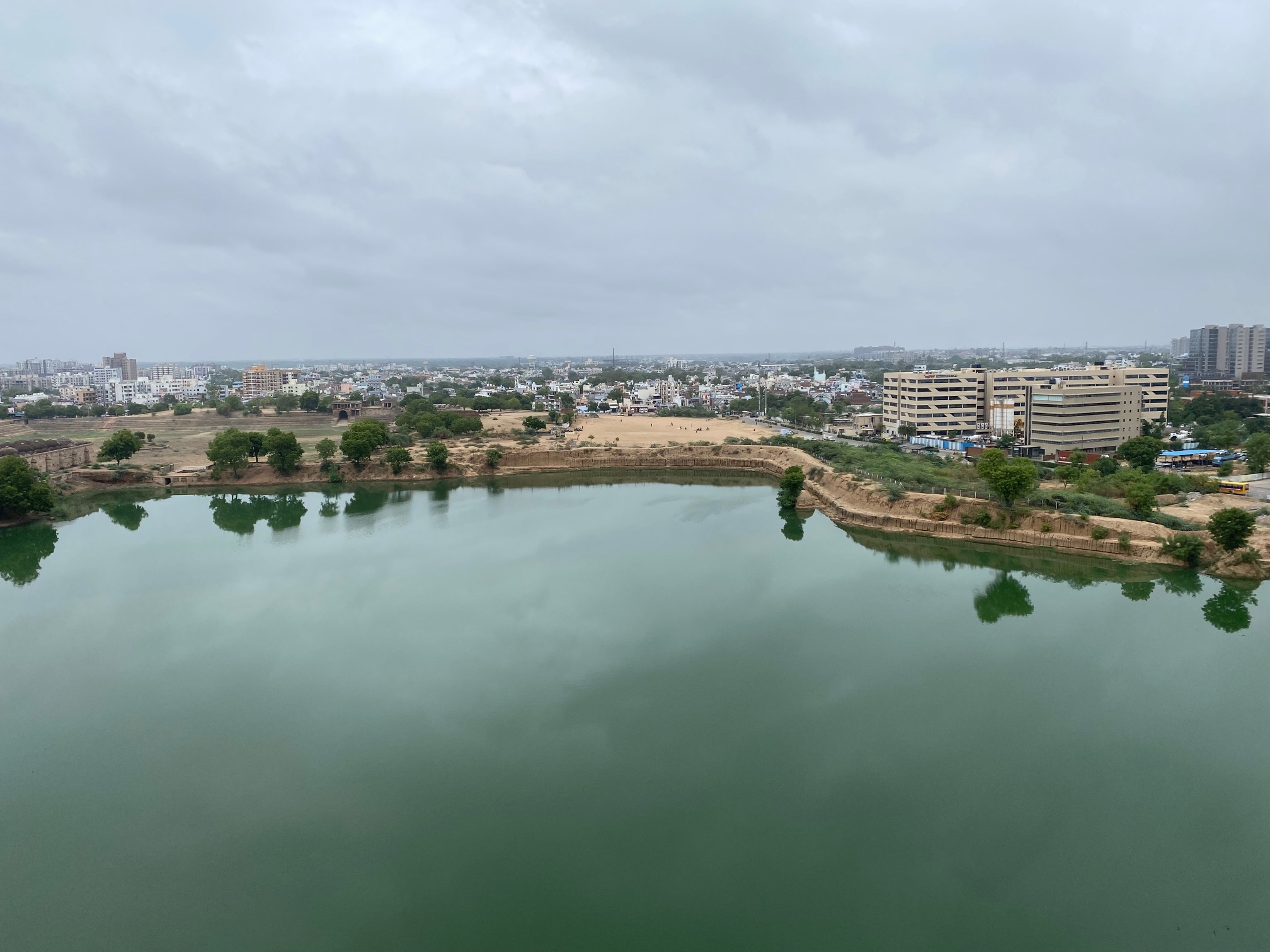
On May 15, 2026, the Brihanmumbai Municipal Corporation imposed a 10 per cent water cut on the city of Mumbai. By May 23, the seven lakes that supply the city – Upper Vaitarna, Modak Sagar, Tansa, Middle Vaitarna, Bhatsa, Vihar and Tulsi held just 2,78,199 million litres against a combined capacity of 14,47,363 million litres, 19.22 per cent of capacity, according to BMC civic data reported by the Free Press Journal (23 May 2026). BMC’s daily supply, normally between 3,950 and 4,100 million litres, was cut to between 3,600 and 3,750.
Two weeks earlier, on April 28, Google broke ground on a US$15 billion AI data centre campus in Visakhapatnam, Andhra Pradesh, its largest single investment in India, per Google blog. Amazon announced US$7 billion in further expansion at its Mumbai and Hyderabad sites. Microsoft committed US$17.5 billion over 2026 to 2029, as reported by TOI (15 May 2026).
These were not unconnected weeks. They are the same story.
On June 3, 2026, the United Nations University Institute for Water, Environment and Health (UNU-INWEH) released a report titled Environmental Cost of AI’s Energy Use: Carbon, Water and Land Footprints, authored by Miriam Aczel, Soheil Chamanara, Mir Matin, Atefe Farsi, Tshilidzi Marwala and Kaveh Madani. It is the first major UN assessment to argue, in plain numbers, that the way the world has so far measured AI’s environmental cost, carbon emissions, mostly, has been missing the larger story.
What the UN report actually says about data centres
The headline numbers from the UNU-INWEH report are sobering. By 2030, global data centres are projected to consume 945 terawatt-hours of electricity nearly triple the combined annual electricity use of Pakistan, Bangladesh and Nigeria, which together house more than 650 million people. Global data centres are estimated to use an additional 448 TWh in 2025. If treated as a country, they would have ranked as the world’s 11th largest electricity consumer, behind France and ahead of Saudi Arabia (UNU-INWEH, 2026).
The associated water footprint of that 2030 electricity demand, according to the report, is roughly 9.3 trillion litres, equal to the basic annual domestic water needs of the entire 1.3 billion people of Sub-Saharan Africa. The associated land footprint: over 14,500 square kilometres, roughly twice the size of the Jakarta metropolitan area.
But the more important argument in the report is not the size of any single number. It is the warning that all three footprints- carbon, water, and land do not move in the same direction.
The trade-off no one is talking about about data centre
Switching electricity generation from coal to bioenergy, the UNU report finds, can cut the carbon footprint of that electricity by 70 per cent on average — while increasing the water footprint more than thirty-fold and the land footprint a hundred-fold.
Judging AI infrastructure on carbon alone risks declaring a problem solved when it has only been displaced — usually onto another resource, often in another place. Renewable-powered AI infrastructure can look spotless on a carbon ledger and still be devastating to a regional aquifer or a tropical forest.
The takeaway from Dr Miriam Aczel, the report’s lead author and a UNU-INWEH researcher:
This is the single most important finding for Indian readers. India is one of the most water-stressed countries in the world: as the World Bank has noted (cited in BBC reporting, May 2026), it holds 18 per cent of the global population on just 4 percent of the planet’s freshwater resources.
The inference shift — why your everyday ChatGPT use is now the problem
For years, the public discussion of AI’s environmental cost has focused on training. Training GPT-3, the UNU report notes, took an estimated 1.3 gigawatt-hours of electricity. GPT-4 has been estimated at 50 to 70 GWh.
The report argues that this framing is now outdated. Inference — the continuous running of deployed models to answer everyday user prompts — accounts for 80 to 90 per cent of total AI energy use, according to the UNU-INWEH assessment. ChatGPT alone is estimated to process 2.5 billion prompts per day, translating to roughly 383 GWh of electricity per year for a single product. The carbon offset required would need 2.6 million tree seedlings grown for ten years.
And the per-query cost varies wildly by what users are doing. A standard conversational chat query uses around 200 times the energy of a basic text classification, the UNU report estimates. Generating a single AI image: roughly 1,450 times that baseline. A single short AI-generated video can match the energy of 200,000 spam classifications.
The report invokes the Jevons Paradox — the historical pattern by which efficiency improvements in resource use are absorbed by increased volume. As AI gets cheaper and faster, more people use it more often, and the aggregate footprint grows even as the per-query footprint shrinks.
Co-author Professor Kaveh Madani, Director of UNU-INWEH and the 2026 Stockholm Water Prize Laureate, captures this in one line in the report’s launch communication: “More efficient and affordable AI and energy mean more consumption of AI.”
How this data centre lands in Indian cities
India today hosts approximately 271 data centres as of January 2026, occupying around 23 million square metres of land, according to a February 2026 white paper from the Council on Energy, Environment and Water (CEEW). Mumbai accounts for roughly 25 per cent of the national total, followed by Chennai, Hyderabad and Bengaluru. Installed capacity stands at approximately 1.5 GW today (2025), projected by CEEW to grow to 4.5 to 6.5 GW by 2030.
The water arithmetic is where it gets uncomfortable.
CEEW estimates that Indian data centres consumed approximately 150 billion litres of water in 2024 (citing Mordor Intelligence) and projects this figure to more than double by 2030. BBC reporting (May 2026) puts the 2030 projection at 358 billion litres.
A typical 1 MW data centre using evaporative cooling — the dominant technology in Indian facilities — consumes around 25 to 26 million litres of water annually, with higher Indian summer temperatures pushing that figure further upward (The Week, May 2026, citing peer-reviewed studies).
These workloads are concentrated, the BBC has noted, in the same urban clusters — Mumbai, Hyderabad, Chennai, Bengaluru that already have the strongest competing water needs.
Hyderabad: the canary that’s already singing
The UNU report’s argument about local water stress is no longer hypothetical for Indian cities.
In Hyderabad, where Amazon established its second Indian centre in 2022, groundwater levels reportedly dropped from 1.99 metres in January 2026 to 2.97 metres in April 2026 — a roughly one-metre fall in three months, according to The Week‘s reporting (15 May 2026). In Mumbai, the BMC’s pre-monsoon water cut was triggered by reservoir storage of just 23.52 per cent on 11 May 2026 (per BMC data reported by India.com), falling to 19.22 percent by 23 May (per Free Press Journal), even as Amazon’s $7 billion data centre expansion across Mumbai and Hyderabad proceeded.
These are not yet causal stories — no one is claiming Mumbai’s water crisis is because of data centres. But the spatial pattern is exactly what UNU-INWEH’s Geospatial, Climate and Infrastructure Analytics Programme Manager Dr Mir Matin highlights in the report: the geography of new data centre construction often overlaps with the geography of existing water stress, while the workloads served by those facilities flow elsewhere.
The mismatch between who hosts the infrastructure and who consumes the AI is, in Martin’s framing in the UNU launch material, the core equity problem.
The international precedents the report cites
The UNU report’s case studies should read like warnings for Indian planners.
Ireland: In 2023, data centres consumed 21 per cent of Ireland’s total metered electricity — exceeding all urban household demand, the UNU report notes. The national grid operator has now paused new data centre approvals around Dublin until 2028, making Ireland the first documented case of AI infrastructure growth outpacing energy planning.
Mexico: In Querétaro, expanding compute infrastructure is drawing on water supplies amid prolonged drought (UNU-INWEH, 2026).
Uruguay: Plans for a water-intensive data centre coincided with a 2023 drought that depleted Montevideo’s freshwater reserves, leaving tap water unsafe to drink, the UNU report documents.
Each of these stories began the way India’s is beginning now — with large foreign investments, regional incentives, and a sense that the infrastructure would somehow take care of itself.
Who pays, and who benefits from data centres
This is where the UNU report makes its most uncomfortable argument.
Only 32 countries in the world host AI-specialised data centres, the report finds. Over 90 per cent of that capacity is concentrated in just two countries — the United States and China. More than 150 countries currently have little or no access to sovereign AI compute infrastructure.
The asymmetry runs the other way for environmental costs. Critical minerals for AI hardware are extracted in jurisdictions, often in the Global South, with weaker environmental oversight, the UNU report notes. AI infrastructure could generate up to 2.5 million tonnes of electronic waste each year by 2030 — equivalent, the report calculates, to discarding nearly 250 Eiffel Towers — much of it processed in low-income economies with limited safeguards.
India sits awkwardly across both sides of this equation. It is one of the world’s largest digital markets, host to a fast-growing share of global AI infrastructure investment, and simultaneously a country whose municipalities — like Mumbai’s BMC — are managing severe water stress, and whose informal-sector workers handle large volumes of imported electronic waste.
What India’s policy is currently incentivising
The Draft National Data Centre Policy 2025, currently moving through consultation, proposes tax exemptions of up to 20 years along with GST input tax credits on capital expenditure for new data centre investments, according to Cushman & Wakefield’s 2026 Global Data Centre Market report. The same report ranks Hyderabad ninth globally among secondary data centre markets in the 2026 edition and notes that Mumbai anchors India’s position as a primary Asia-Pacific market. India ranked fourth globally in electricity production growth between 2022 and 2025.
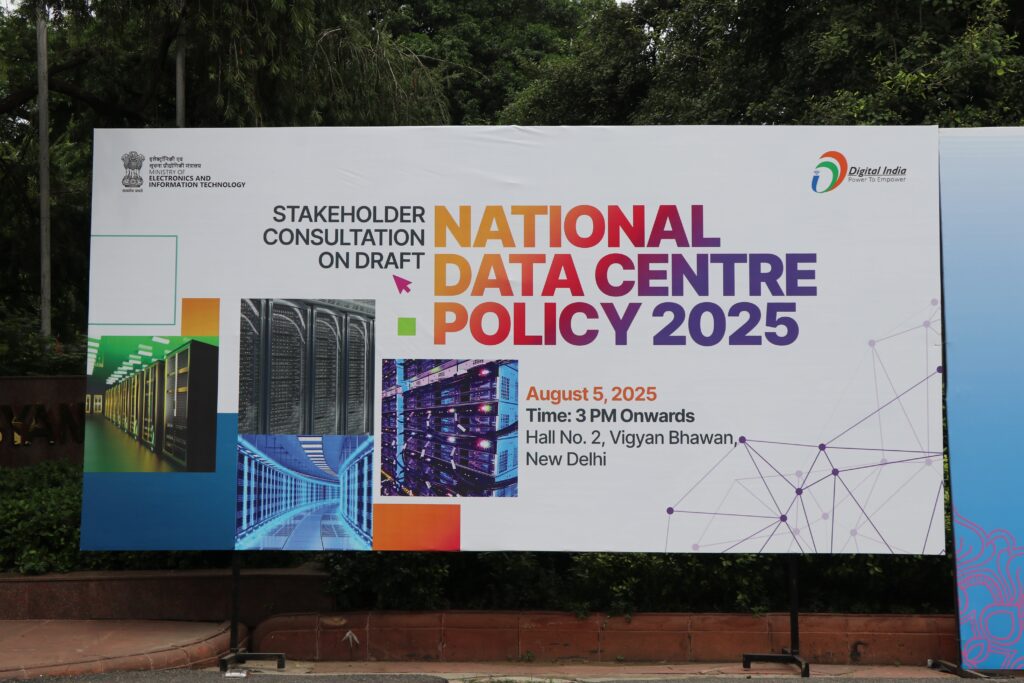
Industry Consultation Meeting of National Data Centre Policy 2025.jpg
The policy instruments, in other words, are pointed firmly at attracting more data centre capacity faster. The water consequences, the land consequences, and the electricity-system consequences are largely treated as questions for some later stage.
The UNU report’s central recommendation directly addresses this. Where a data centre is built — and from which grid it draws power — determines the carbon, water and land profile of the same workload. Permitting, environmental impact assessment and community consultation, the report argues, should reflect this reality and currently mostly do not.
What the report does not pretend to fix
It would be easy to read the UNU report and conclude that what AI needs is better measurement — standardised carbon-water-land disclosure, a global dashboard, a few new metrics. The report does call for those things. But it is careful, at its highest level, to make a different point.
Professor Tshilidzi Marwala, Rector of the United Nations University and a UN Under-Secretary-General, frames it directly in the report’s launch material. AI, he argues, can advance prosperity and human well-being. Whether it does so fairly across countries and communities is, in his words, “a governance question, not a technical one.”
That distinction matters. The underlying issues the report names — opaque siting decisions, the concentration of compute in two countries, the export of e-waste and the import of investment without environmental conditions, the absence of any community consultation in most data centre approvals — are not problems that get solved by adding a footprint counter to the next ChatGPT release. They are political-economy problems, and they will be resolved, if at all, by the political and regulatory choices of the countries hosting the infrastructure.
For India, those choices are being made now. The Draft National Data Centre Policy will be finalised. State governments will compete to attract the next $15 billion. Municipal authorities will issue or decline NOCs for sites near already-stressed reservoirs. None of these is a technical decision, even though they will be argued in technical language.
What residents of Indian cities should be asking
When the next data centre announcement comes — and several more will come this year — the questions that matter are not the ones being asked.
- Which grid will the facility draw from, and what is that grid’s water and carbon profile?
- How much water will the site consume, in litres per year, at what abstraction point, and during which months?
- What is the cumulative impact on the local water table, alongside other existing and approved facilities in the same district?
- Will the project’s electricity demand displace, or compete with, residential connections in the surrounding region?
- Who will own the e-waste ten and fifteen years from now, and where will it be processed?
- Has the local community been formally consulted, with enforceable transparency and grievance mechanisms?
These are the questions the UNU report places at the centre of responsible AI governance. They are also questions Indian cities will increasingly have to ask of their state and central governments — because the data centres being approved this year will be drawing on local water, electricity, and land for the next twenty.
Mumbai’s lakes will fill again with this monsoon, as they do most years. But the trend lines that matter- water tables, electricity demand, land consumed by infrastructure built to serve users elsewhere — keep moving in one direction.
The UN’s argument is not that AI is bad. It is that AI’s costs are presently being borne by the places, communities and ecosystems least equipped to absorb them, and that this is a choice that countries hosting the infrastructure are making, knowingly or not.
For India’s cities, the choice is happening in real time.
Primary source
- Aczel, M., Chamanara, S., Matin, M., Farsi, A., Marwala, T., Madani, K. (2026). Environmental Cost of AI’s Energy Use: Carbon, Water and Land Footprints. United Nations University Institute for Water, Environment and Health (UNU-INWEH), Richmond Hill, Ontario, Canada. doi: 10.53328/INR26RMA002. Published 3 June 2026.
- All UNU report findings cited in this article are drawn from the report and its accompanying launch material on UNU-INWEH’s official press page.
India data centre data
- Council on Energy, Environment and Water (CEEW), February 2026 white paper: How Is Data Centre Infrastructure in India Shaping Power and Water Use? (271 data centres, 23 million sqm, Mumbai 25% share, 1.5 GW to 4.5–6.5 GW by 2030, 150 billion litres of water in 2024, citing Mordor Intelligence). Available at ceew.in.
- Cushman & Wakefield 2026 Global Data Centre Market report: (Hyderabad ranked 9th globally among secondary markets; Mumbai’s APAC primary-market status; Draft National Data Centre Policy 2025 with 20-year tax exemptions and GST input credits; India 4th in global electricity production growth 2022–2025).