

Ahmedabad: India’s events industry has a plastic problem. Every major conference generates piles of empty PET bottles. Most of them never get recycled. Belgrey, a Gujarat-based startup, just powered two major Ahmedabad summits, the GCCI Sustainability Summit and the IIMA Ventures Summit, without a single PET bottle. Its closed-loop glass-bottle model points to a different theory for how India can quit single-use plastic.
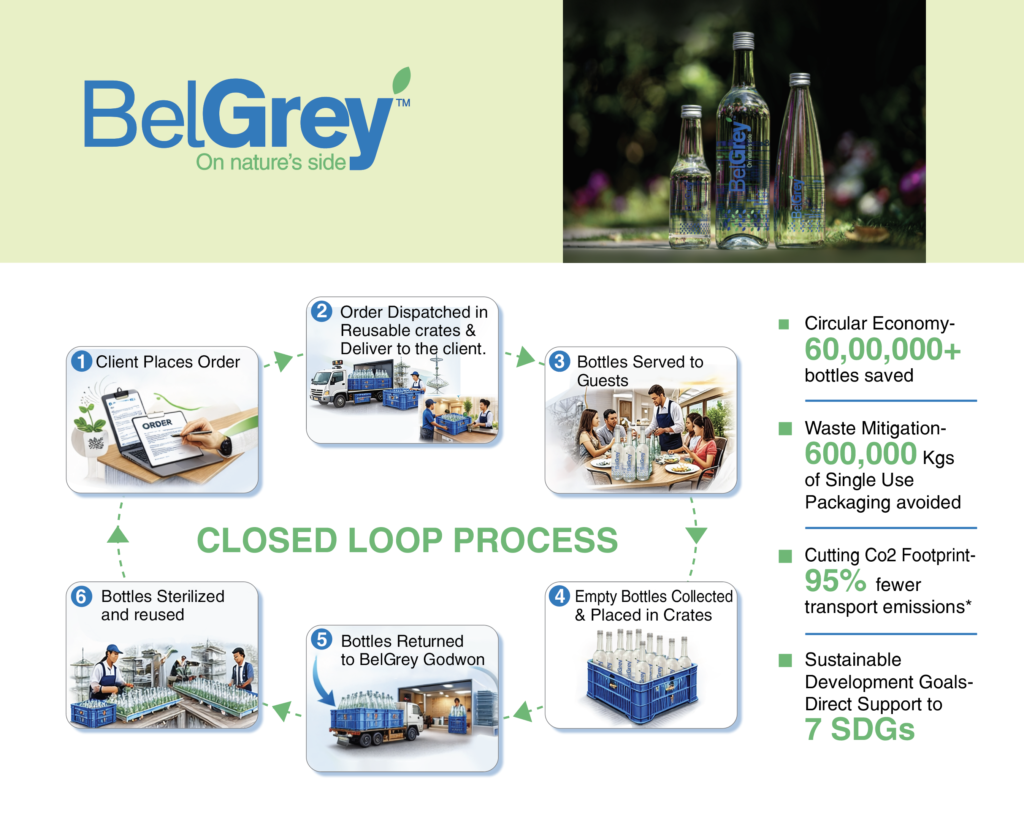
A Gujarat startup is now trying to change that. Belgrey, the consumer brand of Waterly Beverages Pvt. Ltd., headquartered in Gandhinagar, calls itself India’s first circular returnable glass water brand. Instead of selling throwaway PET bottles, it serves water in borosilicate glass bottles. After the event, the bottles come back. The company washes them, sanitises them, and refills them. Then they go out again.
Earlier this month, that model showed up at the GCCI Sustainability Summit in Ahmedabad, hosted by the Gujarat Chamber of Commerce and Industry. Every drop of water served to delegates came from a returnable glass bottle. Not one PET bottle was used.
A few days later, the same setup powered the IIMA Ventures Summit at IIM Ahmedabad. Two flagship summits, back-to-back, with zero single-use plastic — and no inconvenience to a single delegate.
Why conferences are a plastic hotspot
Conferences look harmless on paper. But run the numbers and the picture changes fast.
“Conferences are one of the most visible and most wasteful settings for single-use plastic in India,” says Ashit Chandaria, co-founder of Belgrey. “A two-day summit of a thousand people can easily generate four to five thousand discarded PET bottles.”
Multiply that across the hundreds of corporate summits, government conclaves, and trade shows India hosts every year, and the scale becomes clear. The plastic does not disappear after the event. Most of it ends up in landfills, drains, or low-grade recycling streams that simply break it down further.
This is the problem Belgrey set out to solve.
A bottle that comes back
Ashit Chandaria and Sandip Trivedi founded the company in 2020. Neither came from the beverage industry. But both believed one thing: sustainability shouldn’t depend on individual willpower.
So instead of asking customers to recycle better, they built the infrastructure to do it for them. The company runs regional refill plants. It picks up used bottles through reverse logistics. It cleans and sanitises them industrially. Then it puts them back in circulation. Every returned bottle re-enters the system. None of it becomes waste.
Five years on, the company operates across eight states, with multiple regional plants. It serves the hospitality sector and large-format events.
The numbers Belgrey shares
By the company’s own count, Belgrey has so far:
- Eliminated more than 6 million single-use plastic bottles
- Avoided 600,000 kg of single-use packaging waste
- Achieved transport emissions 85 per cent lower than conventional packaged water peers
- Sustained a 75 per cent bottle return rate across its network
- Recorded a product carbon footprint of 0.152 kg CO₂ per bottle, certified under ISO 14067, the international standard for carbon footprint quantification
Belgrey says that if those six million bottles were laid end-to-end, they would cover the road from Ahmedabad to Delhi and then some. They would also cover an area of roughly 25 football fields.
The company has also picked up several awards along the way. These include the Indian Social Impact Award (2025), Gujarat Tourism Awards for Sustainable Tourism (2024 and 2025), the MSME Award for Dedication to Sustainability (2025), the Prithvi Award for Start-Up Dedicated to Sustainability (2024), and the GUSEC Impact Award (2024).
The shift in thinking in Sustainability
Most sustainability solutions ask people to change their behaviour. Carry a reusable bottle. Sort your waste. Refuse the straw.
Belgrey’s approach skips that step. It changes the infrastructure instead. The delegate at a summit still picks up a bottle, drinks the water, and puts it down. The only difference is what happens next.
“Through our endeavour, six million-plus single-use plastic bottles have been eliminated,” Chandaria says. “Conferences like the GCCI Sustainability Summit show that the alternative is already here. It works at scale. And it doesn’t ask delegates to do anything differently.”
That last point matters most. India’s plastic problem is huge. The behaviour-change approach has been tried for years. The results, so far, have been modest.
What GCCI and IIMA Ventures just demonstrated is something different. They show that the system itself can change — quietly, without fanfare, without asking anyone to feel guilty. The bottle just comes back.
In a country drowning in PET, that may be the more useful idea.