
pedaling towards progress: the 2025 copenhagenize index reveals global cycling divide
The bicycle, once dismissed as a relic of simpler times, has emerged as a powerful symbol of urban transformation in the 21st century. The newly released Copenhagenize Index 2025 demonstrates that cycling is no longer a niche mobility choice but a critical tool for addressing climate change, improving public health, and enhancing urban livability across the globe.
Published in November 2025 and supported by EIT Urban Mobility, this comprehensive ranking of 100 cities reveals both encouraging progress and persistent challenges in the global push toward bicycle-friendly urbanism.
European Excellence Continues to Dominate
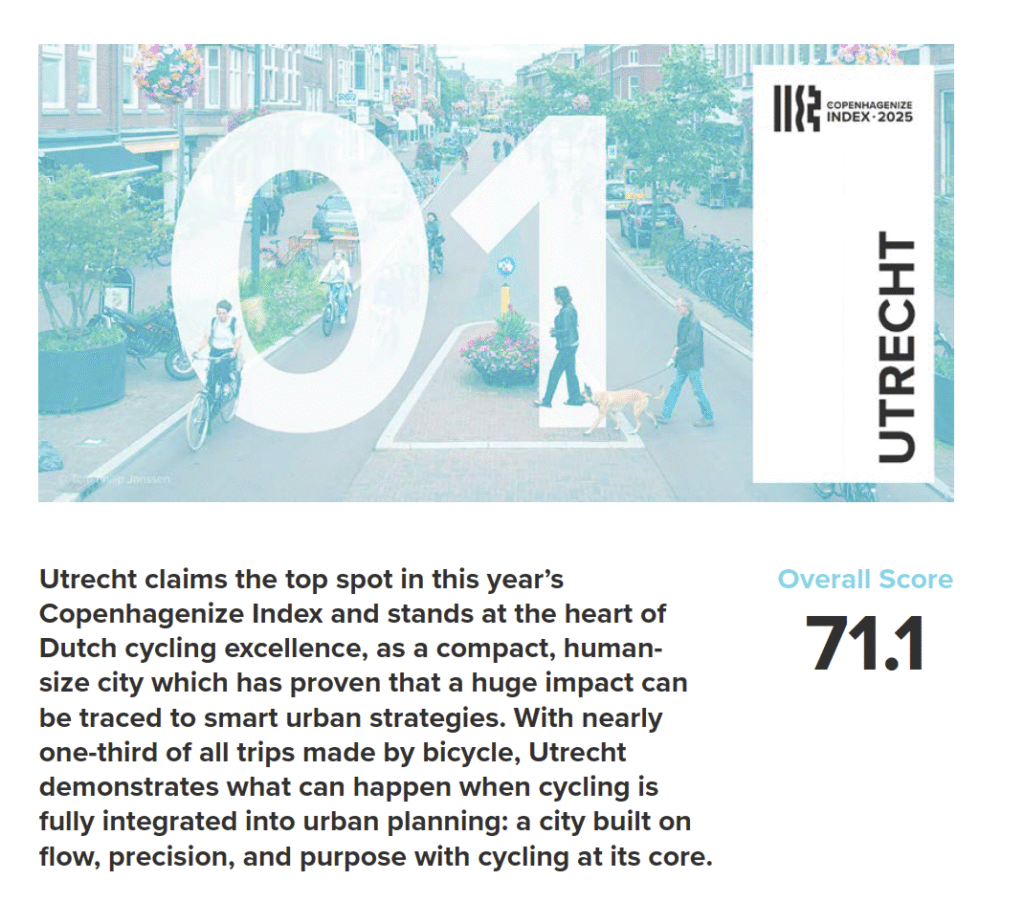
Utrecht has claimed the top spot with an impressive score of 71.1, narrowly edging out perennial leader Copenhagen (70.8). The Dutch and Belgian cities dominate the top rankings, with Ghent, Amsterdam, and Antwerp all appearing in the top ten. Paris rounds out the top five, demonstrating that political will can drive rapid transformation—the French capital has invested heavily in cycling infrastructure in recent years.
What distinguishes these leading cities is their systematic approach. They don’t treat cycling as an isolated initiative but as an integrated system connecting infrastructure, policy, and culture.
EIT Urban Mobility Edition
A striking 90% of the top 30 cities regularly monitor and report on cycling progress, demonstrating a commitment to data-driven decision-making and continuous improvement.
Climate Is No Barrier for Cycling
One of the Index’s most compelling findings challenges the myth that cycling only thrives in temperate climates.
Cities from vastly different climatic zones, Singapore’s tropical humidity, Dubai’s desert heat, Helsinki’s Arctic winters, and Minneapolis’s harsh cold—all feature in the rankings, proving that with proper infrastructure and political commitment, cycling can flourish anywhere.
The key differentiators between successful and struggling cities aren’t geography or weather, but funding stability, political continuity, and technical capacity.
Top-performing cities have established dedicated cycling units, stable funding mechanisms, and robust monitoring systems that transform political promises into measurable results.
The Implementation Gap Persists in Cycling
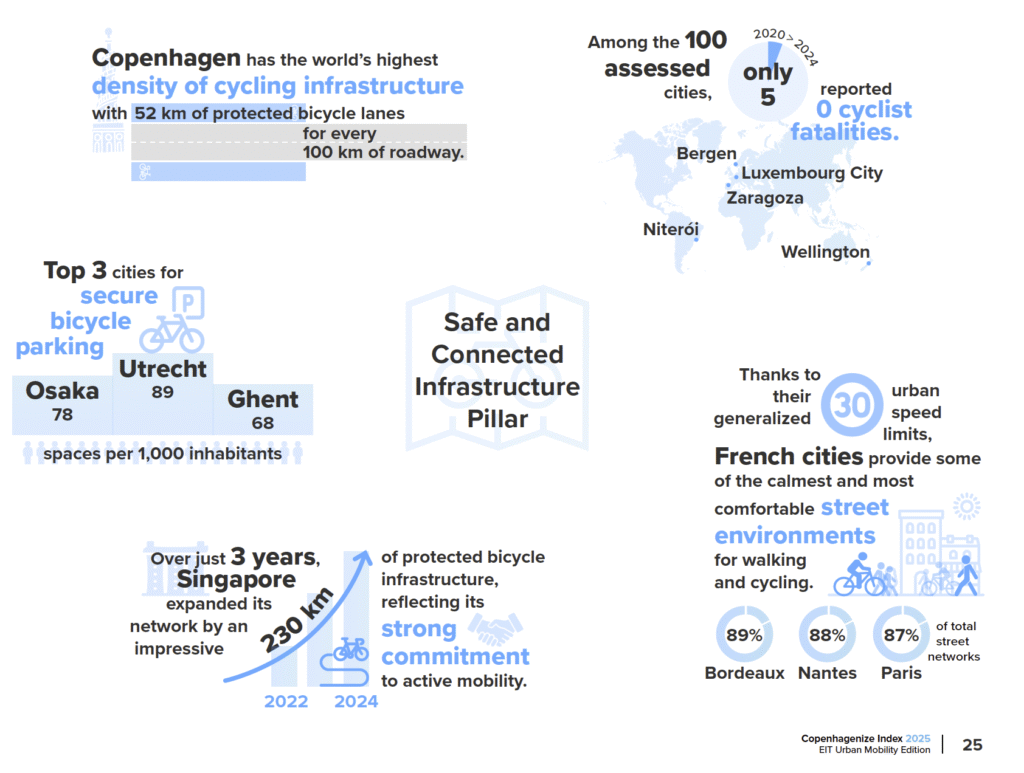
Despite growing global ambition, the Index identifies a troubling gap between vision and delivery. While many cities have adopted impressive cycling strategies post-pandemic, translating plans into protected bike lanes, secure parking, and traffic-calmed streets remains a significant challenge. Some early cycling pioneers in Europe and the Americas have even scaled back their investments, causing them to slip in the rankings.
Ahmedabad’s Paradoxical Presence As a Cycling City
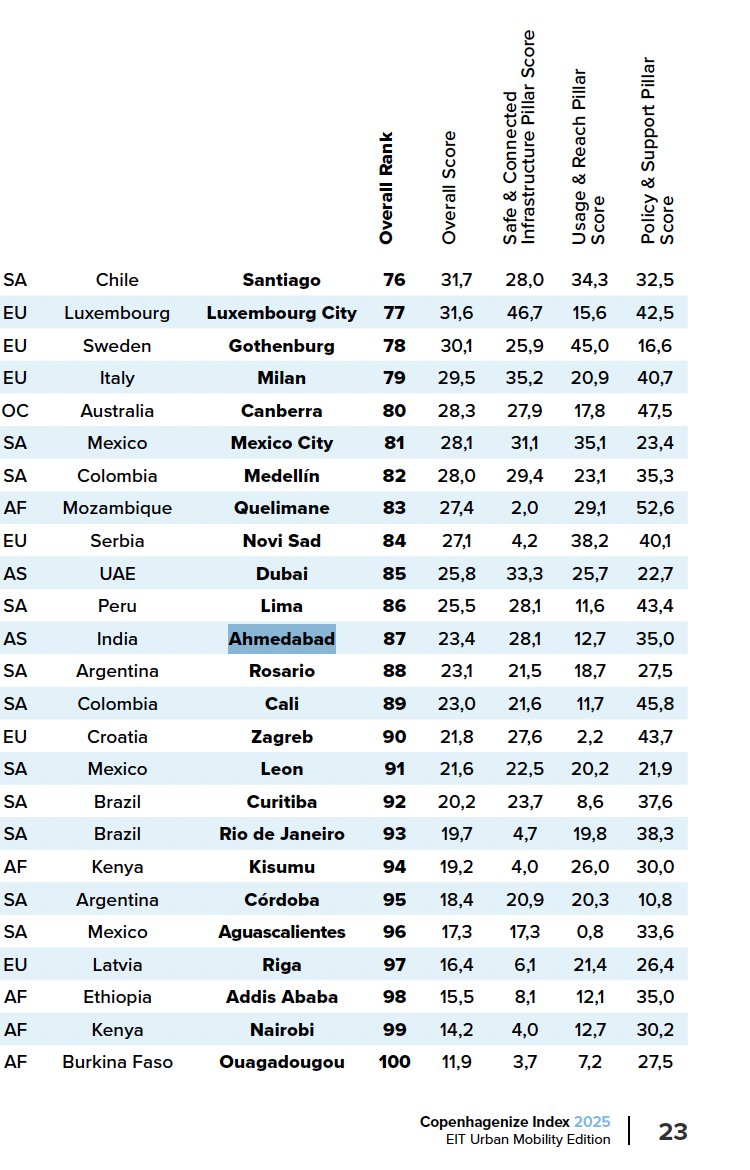
Perhaps no city better illustrates this implementation gap than Ahmedabad, India’s sole representative in the Index, ranking 87th out of 100 cities. With an overall score of just 23.4, Ahmedabad’s inclusion raises eyebrows—particularly given its notoriously questionable cycling infrastructure.
The city’s pillar scores reveal a stark imbalance: while it achieves a relatively respectable 37.6 in Policy & Support, suggesting institutional commitment on paper, its Usage & Reach score plummets to a dismal 12.7. Its Safe & Connected Infrastructure score of 28.1 reflects the ground reality that most Indian cyclists already know—
Ahmedabad’s streets remain hostile territory for two-wheeled commuters.
The disconnect between Ahmedabad’s policy ambitions and infrastructure reality highlights a common pitfall: cities can develop impressive cycling master plans and establish dedicated departments, but without sustained investment in protected bike lanes, traffic calming measures, and secure parking facilities, these remain empty promises.
Ahmedabad’s presence in the Index serves less as a celebration and more as a stark reminder of how far the city and India more broadly must travel to create genuinely bicycle-friendly environments.
Looking Forward To More Cycling Cities in Asia
The Copenhagenize Index 2025 makes clear that cycling infrastructure is not a luxury but a necessity for modern cities facing climate crises and public health challenges.
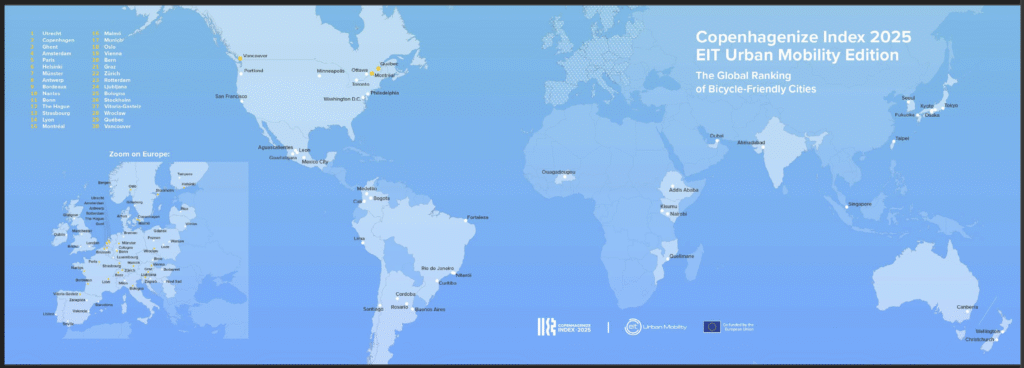
of Bicycle-Friendly Cities/ Asian Cities
The question is no longer whether cities should invest in cycling, but how quickly they can bridge the gap between aspiration and action—a lesson Ahmedabad and countless other cities worldwide must urgently heed.